
You must log in or register to comment.
TIL “leftenant” is not a separate word/rank.
But really, Arkansas’s pronunciation is the fault of America’s 51 state, Hohoq; otherwise known as the floating state of Ar.
What about colonel
ko-lo-NEL
Why don’t you ask the people of Ar-KAN-sass City, Kansas about how the fools in that other state pronounce it.

Oui?
Le nom d’user est vérifié.
Brittish people love dogging on the way French people talk then they stop pronouncing certain syllables whenever poor peoples accents start sounding too close to the rich, and then next thing you know the antebellum Louisiana accent has a more traditional pronunciation of English than anywhere on the Island themselves. What I’m saying is if you keep changing the way you pronounce words every time poor people sound like you you’re just gonna make your own French.
So you’re saying french is not so much a language, as it is a mechanism… like carcinisation.
It could be that the universe itself isn’t meant for collapse, or heat death,… but an unspeakable end : the french crunchfrench press
10 points, sir.
le croustillant français
It is a romance language after all, at one point it was just Latin.
We seem to have the opposite problem in the US, where slang changes once it becomes mainstream, fam.

This complicated and inconclusive answer makes the most sense to me on the first question:
That’s why Kansas is always can-saw to me. Kansasians can’t stand it.
I’m told that in Kansas, they call the Arkansas River the Ar-Kansas River.
Kans-asians?
Kan-sassy-annes!
They should like it. They should call the other state Can’t Saw.
Watched a military analyst talking about French fighters in Ukraine, and had the pleasing sight of him realising that almost all the words unique to the military are French. They did so much fighting that the whole genre is in their language
The Dutch are probably the nautical version of this. Apparently the Russians get their technical sailing words by way of the Dutch for example. Their word for ‘navigator’s’ is shturmanskie which kind of does sound like Dutch filtered through a Slavic language. I imagine it’s a cousin of the term starboard, which comes from the ‘steering oar’ of older vessels which was on the right (since most people are right handed) giving rise to various European equivalents of ‘steersman’, although of course in English we’d call them a helmsman these days. We also get quite a few nautical words from the Dutch in English, ‘yacht’ for example, skipper, deck, sloop etc.
Source: Sailed with a Russian guy once, and also kind of cursed with a thing for Soviet watches.
I have absolutely no idea how the French (me) could have influenced the Brits (my dear/worst frenemies) to pronounce it “leftenant”. Makes no sense to me. Anybody has a possible explanation?
If left to us they would pronounce it “liootahnang” (Southern version) or “liuuuut’nan’” (Northern version)
“Lieu” is ‘in place of’, so to be the lieutenant is to be the ‘tenant’, the person in place, in lieu of a captain.
If the captain is gone, the second in command is left-tenant, the tenant who is left.
I’m sure the real answer is some dissatisfying essay about regional dialects and poor handwriting, but I’d like to Mandala Effect this better answer.
“Leftenant” is actually the older, less adulterated form of the word.
In traditional military units going way back, you’d have a formation of troops all in a line. On the right side of that formation would be the commander. On the left side would be the commander’s “left tenant”.
“Lieutenant” is just a result of people saying “Leftenant” quickly, without care to pronunciation, and – after a certain point in history – forgetting what the word originally meant. “Leftenant” --> “Leatenant” --> “Lieutenant”
No, I don’t think it works. “Lieutenant” comes from “tenir lieu”, that is “taking the place of”, “acting as”. Nothing to do with the left side. That’s why they are just below captain or colonel: they can replace them but don’t have the actual rank.
Nah, he is totally correct. Because in the US they are called rightenents. See, the formations follow the cultural disposition for which side of the road is to be used.
What you say is so true, that in comparison Truth itself sounds like a lie.
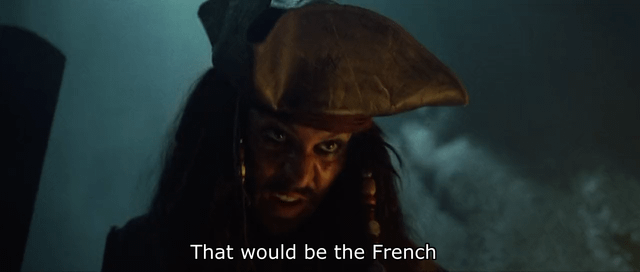
It’s probably the “freedom fries” of its era, I expect Britain and France had beef at the time, as is traditional.
had beef
Sacrés rosbifs
The British have historically “anglicized” French words to “make them English” its also why the pronounce “Marquis” as “Markwiss”.
It’s actually codified in the law books that that’s the way you’re supposed to say it.
Left in it.
Left, innit?
Nothing ironic about it. The french just ruin everything they touch.
Roquefort and Asterix are great though.
When the French make something of their own accord it’s likely going to be good, like baguettes or code lyoko or forlornly smoking a cigarette during a thunderstorm. It’s when they mess with other languages and invade colonize other cultures that they ruin things.
To be fair, every culture that does that is the same
Yeah but I have an extra thing against france because everything people make fun of english for is stuff they did to us :(