
- cross-posted to:
- smbc@discuss.online
- cross-posted to:
- smbc@discuss.online
cross-posted from: https://discuss.online/post/38877381
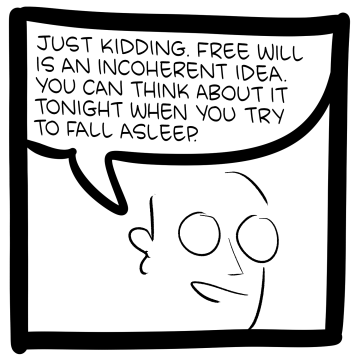
http://www.smbc-comics.com/comic/quantum-6
Alt text
Later they go out for a superposition of chocolate and vanilla ice cream.
Bonus panel
You must log in or # to comment.
Paraphrasing a quote I heard somewhere and can’t attribute to the person
I got no clue if free will exists, but if we stop believing in it we’ll be fucked bad
I heard a philosopher on a podcast who argued the opposite. His position was that the illusion of free will causes us to focus on vengeance as a moral philosophy, which interferes with making the world a better place.
But if there is no free will, we can’t help that or change it, so what difference does it make? Although if that’s true it means we can’t help but discuss it either, since such a discussion has clearly already happened and is happening now as well. If there’s no free will there is no such concept of focus though. If you can’t change or influence your actions that means you must not be able to influence your thoughts either, so someone doomed to a life of philosophy in that kind of world is just suffering endless torment that’s doomed to amount to nothing. That’s how I feel sometimes. At least most people who believe there’s no such thing as free will get to believe there’s some magic man in the sky guiding everything.
Free will is more important to religious people (at least folks who follow Abrahamic religions) than to atheists. It is crucial to unraveling the Gordian knot of God being good, omnipotent, and omniscient (Calvinists being a notable exception).
Actually imo the idea of free will is one of the major flaws with religion. If God is omniscient, that means he knows the outcome of every situation. Why would he create people he knows will ‘sin’, even if it’s their choice, and then doom them to suffer for those ‘sins’. If God is the creator of everything and also all knowing, then he must be intentionally creating doomed, flawed people just to watch them suffer. If free will doesn’t exist, religion becomes much more palatable. Sure, fucked up things happen all the time. But if you can believe that it’s all in service of some eventual greater good, at least that gives some meaning to it. Otherwise God is just a sadistic bastard. This line of reasoning is what broke me away from organized religion. Still not sure where I stand on free-will.
You have discovered the Paradox of Evil:
I’m well aware it’s not an original thought, but as a 13 year old many years ago I was incredibly surprised to find it was one that none of the adults in the church had ever apparently considered or had a response to. The common one was ‘free will exists because God is testing us’ but no one could explain why God would need to test anything when he should already know the outcome, or why he would continue to create people who he knew would fail the test.
How would free will lead to a focus on vengeance?
Yeah but is that being fucked bad a mistake we can avoid or inevitable?
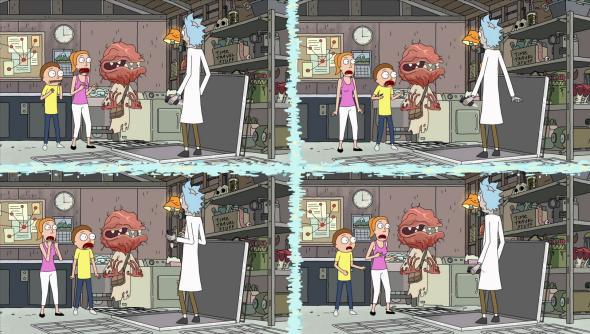
“What the fuck?! Your time is all ripped up to hell! You broke your time, twice!”
Argh, why did that voice actor have to be such a piece of shit? I haven’t seen any rick and morty since he was fired but I have seen some Solar Opposites since he was removed and it’s just… not as good. The guy had a talent not just for making voices but also funny awkward ad-libbing.
I personally thought both shows were just as good (maybe better in some respects) after he left.
I will say that I respected the way they did it in Solar Opposites. Just a gag at the start of the season and then moved on.
“This is what my voice sounds like now. I don’t care if it’s jarring, get over it. And that Voice Changer Ray had chronotons in it, so this is what I’m gonna sound like in flashbacks too. You got a problem with that? Then tough shit, it’s called science!”
Also, if they got rid of the constant burping Rick’s character did, then I would consider that an improvement. Like I get what they were going for but it was kinda gross and off-putting in a different way from the rest of that character.
It was definitely toned down, if not outright removed, and it was an improvement. It got old.
Takes some time to get used to but the new guy is brilliant I think
It’s not that QM means we have free will. It’s that in a worldview where the mind is a purely physical concept, deterministic physics does not allow for free will. The introduction of non-determinism with QM does not imply free will, it allows for free will.
I’ve said this before on Lemmy, but free will is observer-dependent, because when people say “X has free will”, what they really mean is “I can’t predict the behavior of X”. QM doesn’t really change that, it only really affects the theoretical limit of invoking some sort of advanced science or superintelligence. Is it possible that we could build a computer so advanced that it can predict all of humanity’s actions as easily as we can predict the trajectory of a thrown rock with physics? To it, humans wouldn’t have free will. To any individual human, other humans would still appear to have free will though. QM might provide an upper limit on how much one can predict the universe, or maybe a superintelligence could pierce the veil and determine more than we currently think is possible. Also, mechanistic interpretations aren’t entirely ruled out for QM, just certain formulations of them. They’re not in vogue, but not proven wrong:
https://en.wikipedia.org/wiki/De_Broglie–Bohm_theory#Occam’s-razor_criticism
Our main criticism of this view is on the grounds of simplicity – if one desires to hold the view that ψ is a real field, then the associated particle is superfluous, since, as we have endeavored to illustrate, the pure wave theory is itself satisfactory.
Yes! Finally someone mentions this. No one ever seems to acknowledge that they assume some kind of omniscient perspective. Something can’t be determined if no one knows the answer.
I’ll also add two points:
Why do we assume determinism removes our free will? If I were a parent you could bet with almost certainty that I would take a bullet for my child, does that mean it’s not my choice because it’s predictable? And events in the past are almost always determined, but we don’t say our past actions are against our will because they’re known now.
Why do we assume randomness gives or allows for free will? If my muscle spasms randomly it’s not suddenly my choice because it’s unpredictable. And if I found out that a choice I had reasons for committing was actually just a random chance that would be more disheartening than liberating. We only think this gives free will because we assume the random chance and our consciousness are the same thing. But that’s just reinventing the immaterial soul with added psuedoscience.
Something can’t be determined if no one knows the answer.
Yes it can. The trajectory of the planets is well determined and can be predicted many years into the future. That was also true before astronomy, or before humans even. Even if nobody currently knows how to predict something, it can certainly be obeying deterministic rules.
Why do we assume determinism removes our free will? If I were a parent you could bet with almost certainty that I would take a bullet for my child, does that mean it’s not my choice because it’s predictable?
Under determinism there is no such thing as choice. Not whether you take a bullet for your child, not whether you watch TV or read a book, not whether you look at the wall for ten or twenty seconds. If there can be no choice, there can be no free will.
Why do we assume randomness gives or allows for free will?
The proposition is not than random behaviour is free will. The proposition is that since determinism precludes free will, the existence of free will must require a non-deterministic world. This does mean we know anything about how free will works or comes about, and certainly it doesn’t mean that non-determinism implies free will. We can definitely be living in a non-deterministic world without free will.
I disagree. What you mention is unpredictability, not free will. The weather is unpredictable, but hardly considered as having free will.
The important point is not whether you have free will to some observer, rather, the important point is whether you yourself have the experience of free will. Yes, that could be an illusion, but that is always a risk in empirical observation. It is awkward that you are the only one who can experience your free will, meaning it can’t be checked by external observers, but you can compare your experience of free will with others, and see that they have very similar experiences. If we try to be scientific about it, that could be considered evidence.
QM is consistent with an indeterministic physical world. That is indeed not the only interpretation, but it is a valid one. An indeterministic physical world is necessary for free will to be possible. Ergo QM allows for free will. It does not prove free will, but it breaks down a barrier for the existence of free will.
Why doesn’t the weather have free will? It seems like a silly question, but actually gets right to the point.
What exactly is the “experience of free will”? To me, that sounds a lot like “I can’t predict my own behavior”, which in turn is exactly “I can’t predict the behavior of X” as above, where X is oneself.
An indeterministic physical world is necessary for free will to be possible
To me, this sounds like it agrees exactly with free will meaning “I can’t predict the behavior of X”. Why is it necessary for free will? Because what you actually mean by free will is “unpredictability”.
The key difference between unpredictability and free will is the experience of free will, which is the opposite of what you say: my experience of free will is that I can predict my own behaviour quite well through my awareness of my own choices, but nobody else has access to that awareness, therefore they can’t predict my behaviour. I am predictable to myself, to an extent, but not to others. Unpredictability can be a consequence of free will, but it is not equal to free will.
With concepts like awareness and choice we of course have the same problem as when discussing consciousness - I can’t strictly speaking know if anything other than myself is conscious, since the main proof of consciousness is the subjective experience of said consciousness. Therefore I can’t strictly speaking say that the weather doesn’t have free will, in the same way that I can’t say a rock cannot experience joy.
But if we work in the relatively sane framework that rocks and weather do not have consciousness, and you and I do, then the experience of making a conscious choice is the central evidence for free will.
If it was proven that the world is deterministic, then I would consider that evidence irrelevant. But in a non-deterministic world, it becomes compelling.
It seems like we agree that it’s observer-dependent, just different phrasing. I also don’t think “access to awareness” is necessary for predicting behavior, depending on what exactly you mean. I think a sufficiently advanced intelligence could predict your or my behavior perfectly.
Why is that a relatively sane framework? It’s a very anthropocentric worldview to just assume that.
I think a sufficiently advanced intelligence could predict your or my behavior perfectly.
As far as we know, an infinitely advanced intelligence wouldn’t even be able to predict the weather a year from now, so I don’t think you’re right. Assuming of course that the brain is more complex than the weather.
Why is that a relatively sane framework? It’s a very anthropocentric worldview to just assume that.
I haven’t really encountered any serious framings of the world where a rock can experience joy, but I’d be very happy to know more if you know of any.
I guess ultimately it’s more of an empirical approach than an anthropomorphic assumption - nothing about the behaviour of a rock provides any evidence that it has any sort of awareness or consciousness. On the contrary, the available evidence seems rather consistent with the theory that it doesn’t.
There’s no limit to predicting the weather that I’m aware of for an infinitely advanced intelligence, what do you mean exactly? For complexity, are you saying that the brain must be more complex than the weather to predict it?
Moreso weather than rock, but either one, really. Define “awareness” in an empirically testable manner first and then we can start applying it. Until then, it’s the same as arguing about souls or angels dancing on the head of a pin. Any common definition is circular and meaningless, e.g. “aware” - > “conscious” -> “aware”. Is a thermometer aware of the temperature? If not, why?
Either that or hyperdeterminism…
Indeed. But if superdeterminism (I assume it’s the same?) is true, and Monty Python’s Holy grail was filmed in a way to ensure that this experiment comes out non-local, then the scientific method is dead. That feels like cutting off your nose to spite your face, and sort of a paradoxical approach to science.
There are better “deterministic” alternatives out there like many worlds or pilot wave that doesn’t require you to reject the scientific method.
I see it more like time is connected in the same way space is connected.
How does that relate to superdeterminism?
But there are no QM processes in a human body, so it also doesn’t
First of all, that’s not yet completely clear - we hardly have a complete accounting of all biological processes. But it is true that the processes we have accounted for so far are classical.
Second of all, quantum non-determinism still influences classical processes, especially chaotic ones where small shifts in initial conditions have a great effect on the long term outcome. See e.g. the weather, which is an entirely classical phenomenon, but where quantum fluctuations create a floor for how far into the future you can predict the weather even with perfect information and infinite computing power.
So quantum non-determinism allows for classical non-determinism.
Besides, you can just rely on a quantum random in everyday decisions, thus being truly random
But yeah, there might be proceses not yet accounted for
I’m pretty sure there’s a good amount of biological chemistry that relies on Quantum Mechanics so it’s unlikely the human body doesn’t have any. But there’s nothing that would impact the brain and the way we think.
Fun fact neurons are surprisingly binary, they send signals through discrete pulses with different timings. This is ironic because computer neural networks operate more analog with continuous values than real neural networks do. Because of this (mostly)discrete on or off behavior it would actually make the signal of neurons more resistant to the random noise and tiny effects of quantum mechanics.
If QM wanted to affect how we think, it would need to be deliberately amplified in a way we don’t see anywhere.
That’s what I love about being a dad. There’s always someone who thinks your super smart and who laughs at your jokes.
Or later rolls their eyes at them, which is a similar level of preciousness.
I’m a video game nerd, too, so I know what game you’re playing at a glance, but I’m going to ask if you are having fun doing <insert activity that combines things (mispronounced) from all the games I’ve seen you playing except the one you actually are> until you stop correcting me with exasperation.


![Quantum [SMBC]](https://discuss.online/pictrs/image/12cdcf9d-eda8-4eed-b025-1eae09419199.png)