The study was paid for by the device manufacturer.
So the question is was anything faked or misleading? Or did they actually find that this worked? What is it about the study that seems off?
You can’t just point at money and go “See? fake.” That’s caveman shit.
Like, of course the people who make the devices want proof that they work. However can you point to where their money influenced the outcome of the study, beyond facilitating its existence? Was their method of sample selection biased toward successful outcomes? Did they neglect to include other therapies tried in conjunction or other confounding variables? Did they straight up fake any data?
It doesnt matter if they paid for it, if the results end up being true. What I am looking for is criticism of the methods that invalidate the results. Are there any?
Too often contrarianism is confused and substituted for critical thinking. However to read anything about any new product without contrasting Astro turfing or propaganda is naive
anything not double blind should be immediately ignored unless the ask is for more funding for non biased studies
C.R.C. has received research support from the American Foundation for Suicide Prevention, Assurex Health, August Busch IV Foundation, Barnes-Jewish Hospital Foundation, LivaNova, National Institute of Mental Health, and the Taylor Family Institute for Innovative Psychiatric Research. He has also consulted for LivaNova. A.J.R. has received consulting fees from Beckley Psytech Inc., Better Up, Inc., Compass Inc., Curbstone Consultant LLC, Emmes Corp., Evecxia Therapeutics, Inc., Holmusk Technologies, Inc., ICON, PLC, Johnson & Johnson (Janssen), LivaNova, MindStreet, Inc., Neurocrine Biosciences Inc., and Otsuka-US; speaking fees from LivaNova and Johnson & Johnson (Janssen); and royalties from Wolters Kluwer Health, Guilford Press, and the University of Texas Southwestern Medical Center, Dallas, TX (for the Inventory of Depressive Symptomatology and its derivatives). He is also named co-inventor on 2 patents: US Patent No. 7795033: Methods to Predict the Outcome of Treatment with Antidepressant Medication, Inventors: McMahon FJ, Laje G, Manji H, Rush AJ, Paddock S, and Wilson AS; and US Patent No. 7906283: Methods to Identify Patients at Risk of Developing Adverse Events During Treatment with Antidepressant Medication, Inventors: McMahon FJ, Laje G, Manji H, Rush AJ, and Paddock S. S.T.A. is a consultant to Genomind, Janssen, LivaNova, Neuronetics, and Sage Therapeutics and has received research support from Compass Pathways and Neuronetics. M.T.B. is a former employee of and current consultant for LivaNova. C.G. is an employee of LivaNova and holds LivaNova stock. M.S.G. has received research support from Abbott, LivaNova, Neurolief, and Magnus Medical. He consults for Abbott, Hospital Corp of America, the Jacob Zabara Family Foundation, Neurolief, and Sooma. P.R.-P. is a consultant for LivaNova, Janssen Pharmaceuticals, Motif Neurotech, and Abbott Neuromodulation. R.M.A. has received research support from LivaNova, Compass Pathways, MindMed, Transcend Therapeutics, Wave Neuroscience, Magnus Medical, Janssen, Kernel, Usona Institute, and Alto Neuroscience. She has served on the advisory board for LivaNova and consulted for Starfish Neuroscience. Z.N. is a consultant to LivaNova, Magnus Medical, and Motif and has also received research support from LivaNova. C.L.K. has no conflicts to disclose. J.Z. receives research support from Boehringer Ingelheim, Compass Pathways, Hoffman-LaRoche, Johnson & Johnson (Janssen), LivaNova, Otsuka, Neurocrine Bioscience, and Sage Therapeutics and has received consulting fees from Alfasigma USA and Johnson & Johnson (Janssen). D.L.D. receives payment for clinical services for a former research patient from LivaNova, is a speaker for Janssen (esketamine nasal spray), and conducts forensic consultations, independent medical evaluations, and legal testimony for various firms. J.Q. has clinical research support from LivaNova, Neumora Therapeutics, and Johnson and Johnson; has been a consultant for LivaNova; and receives copyrights from Artmed Editora, Artmed Panamericana, and Elsevier/Academic Press. Y.S. has no conflicts of interest to declare. W.D. has received research support from Abbott Nutrition, AbbVie, Acadia, Akili, Alkermes, Allergan, Alto Neuroscience, AriBio, Axsome, Biohaven, Bionomics, Clexio, Compass Pathways, Corcept, Corium, Denovo Biopharma, Emalex, GlaxoSmithKline Biologicals, Hoffmann-LaRoche, Intra-Cellular, Ironshore, Janssen, Jazz, LivaNova, Lumos, Merck Sharp & Dohme, Neurocrine Biosciences, NRx, Otsuka, Sage Therapeutics, Sanofi Pasteur, Shire, Sirtsei, Spark Neuro, Sumitomo, Sunovion, and Supernus. He is on a speakers bureau or advisory board or is a consultant for Abbott Neuromodulation, Corium, and LivaNova. B.J.M. received research support from NIH, NSF, Wellcome Leap, PCORI, Health Rhythms, LivaNova, Compass, and Abbott and consulting fees from Inside Edge, VML, Atheneum, Guidepoint, Kx Advisors, and S2N Health. M.S. states the following disclosures: LivaNova, Compass Pathfinder Limited, Neurocrine Biosciences, Neumora Therapeutics, Lilly, and Eisai. G.A. receives research support from AbbVie, Accera, Axsome, Axovant, Biogen, Eisai, Eli Lily, Neurotrope, Genentech, Intra-Cellular, Janssen, Lundbeck, Neurim, Novartis, Otsuka, Roche, Sage, Suven, and TransTech and is on the speakers bureau of and a consultant for AbbVie, Acadia, Alkermes, Axsome, Biogen, Janssen, Idorsia, Lundbeck, Myriad, Neurocrine, Nestle, Otsuka, Sage, Sunovion, Teva, and Takeda. L.M. has received research funding administered through Stony Brook University from Janssen Pharmaceuticals (developer of esketamine) to conduct clinical trials with esketamine, received research funding administered through Stony Brook University from LivaNova (the developer of vagus nerve stimulation [VNS] technology) to conduct clinical trials with VNS, and served as a consultant and member of the Spravato speakers bureau for Janssen Pharmaceuticals. Q.T. is an employee of LivaNova. C.F.Z. served on the Scientific Advisory Board of Sage Therapeutics and had equity in the company. He has received royalties from Oxford University Press and research support from the Taylor Family Institute for Innovative Psychiatric Research and the Bantly Foundation. M.M. discloses the following over the last 24 months: (1) Received research support from Alto, Boehringer Ingelheim, LivaNova, Janssen, Merck, Neurocrine, Otsuka, SAGE, PCORI, and NIH/NIMH. All clinical trial payments were made to the University of Alabama at Birmingham. (2) Served as a paid consultant for the CME Institute, NuSachi Labs, PharmaTher, Residents Medical, Tactical Mind Solutions, and the University of Missouri. (3) Received royalties from Springer Nature for textbooks published. M.B. has the following disclosures to declare: AbbVie, Intra-Cellular, Axsome, Janssen, and Teva. He is also a consultant for LivaNova. C.C. has received research support for conducting clinical trials from AFSP, Clexio, ATAI, and Janssen and consulting fees from Compass Therapeutics and Boehringer. J.I.B. receives research support from Teva Pharmaceutical Industries Ltd, Intra-Cellular Therapeutics, J&J Innovative Medicine, and Relmada Therapeutics for clinical trials, administered through the Southern Illinois University School of Medicine. He has received research support from Janssen Research and Development to conduct clinical trials with esketamine, which are also administered through the Southern Illinois University School of Medicine. H.B. has no conflicts to disclose. J.W. is a former employee of LivaNova and holds LivaNova stock. O.S. is an employee of LivaNova and holds LivaNova stock. Y.-C.(L.)L. is an employee of LivaNova and holds LivaNova stock. R.H.M.-W. reports acting as TSC chair for the NIHR HTA-funded SNAPPER trial and DMC chair for the EU-funded PReDicT study. He is Director of Education for the British Association for Psychopharmacology, receives support for meetings via Janssen-Cilag, and receives payments/consultation fees from LivaNova, Janssen-Cilag, Sage Therapeutics, P1Vital, Takeda, and Lundbeck. R.S.M. has received research grant support from CIHR/GACD/National Natural Science Foundation of China (NSFC) and the Milken Institute; speaker/consultation fees from Lundbeck, Janssen, Alkermes, Neumora Therapeutics, Boehringer Ingelheim, Sage, Biogen, Mitsubishi Tanabe, Purdue, Pfizer, Otsuka, Takeda, Neurocrine, NeuraWell, Sunovion, Bausch Health, Axsome, Novo Nordisk, Kris, Sanofi, Eisai, Intra-Cellular, NewBridge Pharmaceuticals, Viatris, AbbVie, and Atai Life Sciences. H.A.S. serves as a scientific advisor and receives consulting fees from Cerebral Therapeutics, Holmusk Technologies, LivaNova, MECTA Corporation, NeuroInsights, Neurolief, Neuronetics, Parow Entheobiosciences, and SigmaStim; receives honoraria and royalties from Elsevier and Oxford University Press; is the inventor of nonremunerative US patents for focal electrically administered seizure therapy, titration in the current domain in electroconvulsive therapy (ECT), and the adjustment of current in ECT devices, each held by the SigmaStim Corporation; and is also the originator of magnetic seizure therapy.
The statistical analyses that are reported in the article will be shared upon reasonable request to the corresponding author. The raw data are not publicly available.
It doesnt matter if they paid for it, if the results end up being true. What I am looking for is criticism of the methods that invalidate the results. Are there any?
Counter point, “fat makes you fat,” “sugar is necessary for a good diet,” “fluoride in drinking water improves tooth health,” “leaded gasoline is harmless,” “leaded paint is safe,” etc. Many of these were held “scientifically true” for years and had plenty of “peer-reviewed” science behind that assertion.
Except it wasn’t really peer-reviewed. And it was never scientifically proven. Despite the hundreds of research papers that all “passed” peer review.
That’s why researchers now have to declare their financial sponsorships in honest science journals, because it automatically means whatever results they’re claiming should not be trusted until peers without any financial incentive review the findings. This claim has not been reviewed in that way, so this assertion has the same value as a random lemmy comment.
Snuck in flouride there huh.
I’ll have to find the link but flouride in drinking water has been shown to do little, if anything, to affect tooth decay. It also isn’t harmful to our health in concentrations found in tap water. More of a neutral thing than the “flOuRidE Is goNnA cAlCifY yoUr PeeNer GlAnD” that usually gets associated with people saying flouride doesn’t work. Idk what side of that argument the person you responded to is on but it’s not entirely unfounded
Edit: I had it wrong. It’s not that flouride in our water isn’t helpful, it’s just that topical flouride in things like toothpaste is more helpful, so in places where flouride is available in topical products, you won’t see much of a benefit from it.
My buddy moved to Oregon where they don’t add fluoride to the water, and recently saw a dentist. The dentist could immediately tell he was from out of state and advised him he’d have to add supplementary fluoride rinses to his dental hygiene regimen to compensate.
I thought that was pretty cool the dentist could eyeball how impactful fluoride in the drinking water was.
They removed flouride from the water in the backwards antiscience hick province er I mean Alberta and now the rates of oral health issues in kids is much higher
Theres direct evidence that morons choose to ignore
Theyre a simple folk, people of the land
At a time where rural dental care is poor to nonexistent and dental care is usually not covered under health insurance we shouldn’t be promoting MORE tooth decay.
it gets worst , since people also buy into the flouride free toothpaste, usually with or without nHA, and what a surprise the people in the reviews for those toothpaste ends up having bad teeth and still cavities. the people reporting thier "teeth or whiter or fresher attributes to it being nHA or flouride free, but dont account for the amount abrasives and whitening agents in these toothpaste, and since its not really standardized, since theres many different toothpastes flouride free made by different companies, people have reported allergies to it(ulcers or chelitis)
I edited my comment and straight up said I had it wrong. You’re getting upset with the wrong person. Use topical flouride, it works so well that it obscures the benefits of flouride in water. If you’re not gonna use flouridated toothpaste or mouth rinses, then flouridated water is better than nothing
My apologies and I agree with you
Call me the Aluminium mining industry the way I sneak fluoride into places it may or may not belong depending entirely on your trust of government authorities in capitalism.
I actually have you tagged as aluminum mining idiot, and I was wondering why.
Yeah, idiot spreading little known history that is backed by every single historian.
It happened. Whether or not you think it was a good thing depends on whether you believe the 1950s US government were corrupt or not. You know, the government that hunted down nazis… to recruit into its own ranks and was bribed into allowing leaded gasoline and sugar industries to do whatever they wanted to the American public while also giving black men syphillis and refusing to treat them while directly lying to them in order to study its effects.
Flouride is good for your teeth buddy.
It sure is, in concentrations 100-1,000x what is found in drinking water, and when applied topically, not swallowed.
where are you applying topical flouride, and why are you eating it to begin with. also its not commercially available to normal people.
No, it was originally noticed as a result of naturally occurring in water. Not at those concentrations and it was swallowed.
Drink more water
I drink plenty of filtered water, like most Americans, which removes the fluoride.
Ah yes, Americans, the epitome of health. One could never guess that you dont drink fluoride, amazing.
Regular filtering doesn’t work you need reverse osmosis or other specialized filters
At the time people thought fats made you fat (calories in and out still matter though). Knowledge and our understanding of nature advances, it doesn’t mean there was some grand conspiracy. People 50 years from now may say “I can’t believe those fools legalized pot.”
Just because someone paid for something doesn’t automatically discount it.
Except it wasn’t really peer-reviewed.
It was. The editorial board appoints reviewers.
Knowledge and our understanding of nature advances, it doesn’t mean there was some grand conspiracy.
Except, you know, it was a grand conspiracy. It was not “our understanding” or “knowledge.” It was blatantly the sugar lobby making up “science” and presenting it as fact in order to justify government aided and subsidized expansion. This actually happened. This is an uncontroversial fact.
https://home.sandiego.edu/~jkua/access396/SugarIndustry_NYT.pdf
https://longevity.stanford.edu/how-the-sugar-industry-shifted-blame-to-fat/
You cherry picked one subject to make a grand hand waving argument about everything.
Flouride does not make teeth healthy!?!
Only one way to find out…
Isn’t the case that manufacturers usually do the studies of their health products like medicinal drugs and vaccines?
I knew a snake oil saleswoman who did “vagus nerve massage” fucking gentrifying bitch scammed people (AND CHILDREN) with serious illnesses. I hope you went back to fucking Wisconsin you God damned stupid idiot bitch from hell
Clinical trials are paid for by the developer.
Next up in the news: water is wet.
Who else will conduct a study on your shitty new to market product.
The question should be: has someone peer reviewed now that the claims are out.
If it’s a proper peer reviewed study that doesn’t matter. All researchers get paid.
This is not the first study I have seen linking Vagus nerve stimulation to a dramatic improvement in mental health. That said, the same results can be achieved through regular abdominal exercises. Crunches, sit-ups, etc, all stimulate the vagus nerve. If you activate your abs regularly, you should achieve the same results as this device.
EDIT: Another link between abdominal work and brain function.
https://www.psypost.org/scientists-discover-a-hydraulic-link-between-the-abdomen-and-the-brain/
Singing is known to stimulate the vagus nerve, and also releases a bunch of endorphins and is tied to stress reduction and improved emotional state. I feel like we don’t sing enough in Western culture.
If you tell me you can’t sing, I say cup your hand around your ear to help you hear yourself better and practice! Or just belt joyously out of tune in the shower!
I struggle with depression and have always sang to make myself feel better! That’s fascinating that it’s related to the vagus nerve, I never knew.
I am also terrible, but who cares! At least I’m no Yoko Ono.
Make a joyful noise!
If you don’t think you can sing, stop giving a shit about what other people think about it.
I feel like we don’t sing enough in Western culture.
When you say “in Western culture”, do you mean “in my local microcosm of America that I assume is reflective of roughly half the geographical planet”?
Cause fuck, man, take a trip to the Maritimes or something.
Fair enough! I’m not an expert on all things cultural, that’s for sure! I just want people to sing more. :)
I just want you to come to any Canadian bar or pub and belt out “I was told we’d cruise the seas for American gold, we’d fire no guns” and it should go a little something like this:
Oh yeah, nice! an Ausie favourite is “am I ever gonna see your face again…” don’t be offended by the response though, it’s meant in fondness and comradery. Go sing that in any pub, it would have a fantastic response.
Yeah exercise never helped with my depression, not in around 40 years of living with it.
deleted by creator
Yes. In fact I’ve spent a lot of time trying and failing.
deleted by creator
Oh I’m as good as is possible. 7 medications, something for my DNA mutation, and therapy. I only think about death and not about dying when I go to sleep at night. It’s the best.
Same, I’ve battled chronic depression since 1989 and exercise has had a nominal effect. That said, what the studies seem to suggest is that a lot of core/ab work, as well as vagus muscle work, seem to help. So not just regular excercise.
Prostate stimulation usually causes people to bear down with their abs from how good it feels. So clearly your pulling double duty on depression fixing with that.
Thank you for this, I had no idea!
It’s worth noting the trial was funded by LivaNova, the company that manufactures the VNS device, which has a financial interest in the trial’s outcome.
…
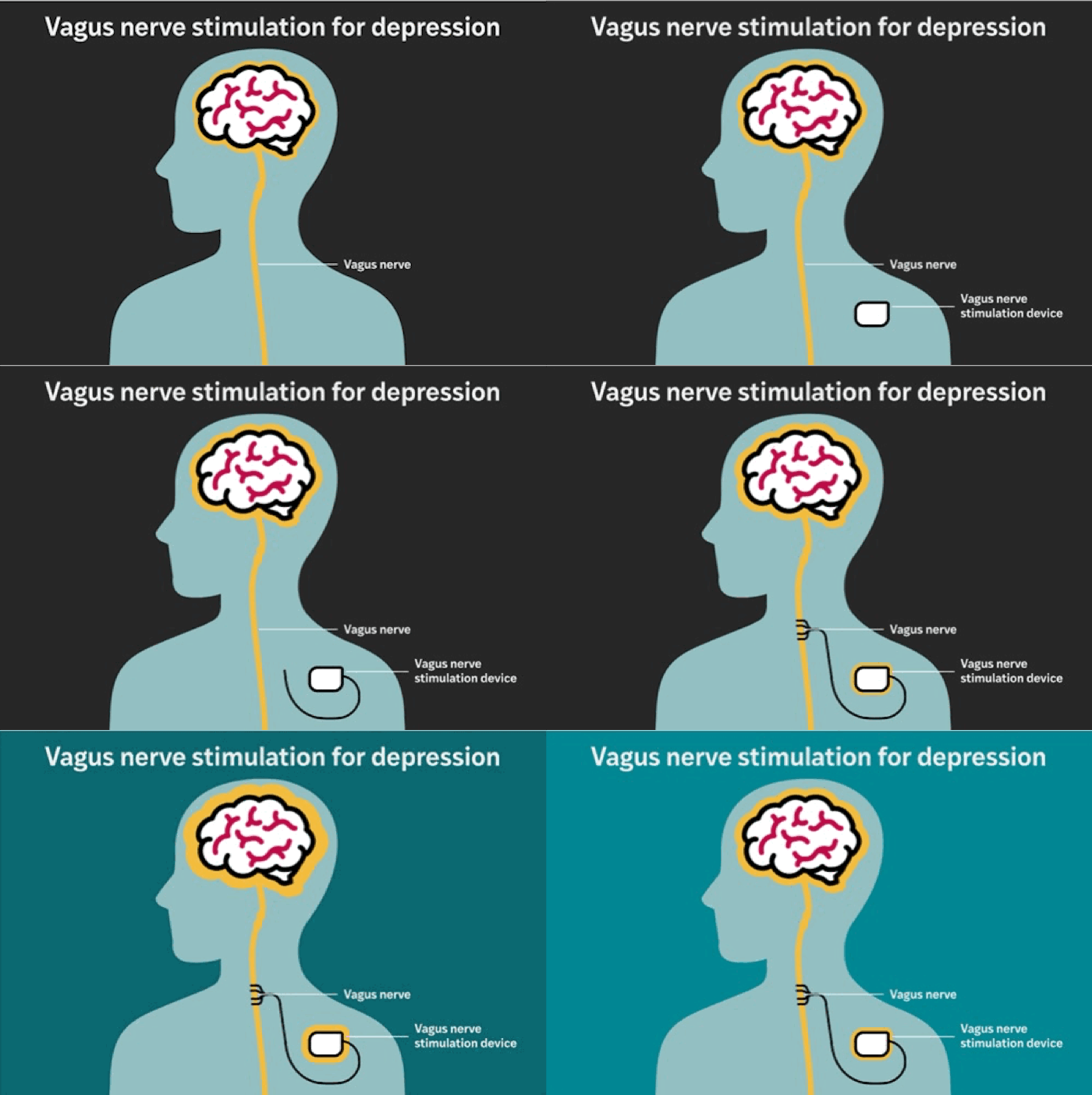
The US FDA approved VNS for treatment-resistant depression in 2005, though exactly how it works on depression isn’t fully understood.
They make a device with no idea of what it does, then fund a study to see if they can call it a miracle.
Honestly, look into pain killer studies. We still don’t know how many of them work even though we know that they do work. The brain and nervous system is weird.
Anesthesia, we have no idea how, just that it works
At the end of the day, enough empirical data over a long enough time frame will have to do, especially if there are no alternatives. Sure do like me a good mechanism though, especially for new things, gives a clue as to long term side effects.
I heard that in Fillion’s voice, lol. Shiny.
Genuinely, we’re better at preventing memory formation and experience of pain than actual sedation. Patients can be cognitively present, and the reason they’re not traumatized from a experiencing a surgery is that we’re preventing the experience from leaving a mark on the brain
Honestly, look into pain killer studies. We still don’t know how many of them work even though we know that they do work.
Tylenol (acetaminophen/paracetamol) is one of the most used painkillers and we still don’t know the mechanism of action.
but it tends to be weaker than the nonselective cox inhibitors, otc nsaids.
You’re describing most discovered medicines. But you probably meant “…with no idea why it works…” Since they already saw the outcomes often enough that they want to productize it.
You can do mild vagus nerve stimulation with deep breathing, as others have noted, as well as any number of other activities, methods and/or devices.
But speaking solely for myself, I often start meditation with vagus nerve stimulation in its simplest form, that of taking a few deep breaths that are OUT longer than they are IN.
So if I breathe IN for a count of four, I might breathe OUT for a count of seven or eight. My post-covid lungs are not the strongest, but it’s not a competition: you just breathe OUT longer than you breathe IN.
I do it two or three times to change speed and for me it has a deeply grounding, settling effect.
I’m sure others have far more formal procedures, but I can’t be bothered: this simple one works for me.
Oh is THAT why that feels so good, huh. I thought I was just really talented at calming myself down
“Vagus nerve stimulation,” new kink unlocked?
Are you saying that it is or is NOT in my butthole?
Whatever, gonna stimulate that part anyway.
Anal absolutely stimulates your vagus nerve
On the subject of the vagus nerve and the brain…
There has been a strong correlation between the vagus nerve and Parkinson’s. The vagus nerve goes from the gut straight to the brainstem, that has a neural pathway to the substantia nigra which produces dopamine for muscular control. People who have had their vagus nerve cut due to severe stomach ulcers (vagotomy) have been shown to have a significantly lower rate of Parkinson’s. One thought is that the nerve acts as a pathway for toxins to travel from the gut straight to the brain (Braak’s Hypothesis). There are also studies into dementia and a “silenced” vagus nerve.
Normally, the vagus nerve tells a part of the brainstem (the locus coeruleus) to spray the hippocampus with a chemical called norepinephrine. This chemical acts like a shield, lowering brain inflammation and protecting memory. If the vagus nerve is damaged or quieted by gut toxins, the hippocampus loses this protective shield, leaving it vulnerable to dementia damage.
norepinephrine
I like to spray my hippocampus with the stuff, but I just use adderall instead.
One of the more notable drugs in the stimulant class is amphetamine, which acts as a dopamine and norepinephrine analog, reuptake inhibitor, as well as an agent that increases the amount of global catecholamine signaling throughout the nervous system by reversing transporters in the synapses.
I didn’t know what a vagus nerve was, I just assumed stimulating your bean would probably lift your mood.
The vagus nerve is actually super interesting and bizarre. It’s this weird long nerve that starts in the upper spinal column and then goes down to connect to a whole bunch of different systems in the body. It’s pretty unique and it seems to have all kinds of weird effects we’re still figuring out.
I wonder then if other sorts of vagus nerve stimulation are effective. Because you can stimulate your vagus nerve with deep breathing, Valsalva maneuver, and lots of other things.
4:6 Deep breathing has been shown to increase heart rate variability, so I wouldn’t be surprised to hear it had other positive effects as well.
That study does say none of the breathing techniques tested had an effect on mood though.
Doc, I need my vag stimulated, I’m depressed.
If you poke it enough you can force it to not be depressed for a while but I wonder if that’s a good idea in the long term.