
I guess I’ve always been confused by the Many Worlds Interpretation of Quantum Physics and the fact that it’s taken seriously. Like is there any proof at all that universes outside of our own exist?
I admit that I might be dumb, but, how does one look at atoms and say “My God! There must be many worlds than just our one?”
I just never understood how Many Worlds Interpretation was valid, with my, admittedly limited understanding, it just seemed to be a wild guess no more strange than a lot things we consider too outlandish to humor.
You must log in or register to comment.
deleted by creator
Thank you for making the point so cleanly. I was about to piss a lot of people off
You can probabilistically prove the many worlds exist, because it implies quantum immortality. Just connect a short-half-life Schrödinger mechanism to a nuclear bomb, and some of you will survive for a statistically impossible number of half lives. That version of you will have proven the many worlds to be true.
deleted by creator
Except you might be the person who survives!
Except you might be the version who survives!
Except you might be the person who survives!
I don’t think it proves many worlds any more than it proves you have a fairy godmother manipulating quantum states for you. All you’ve done is shown an unlikely occurrence happened, not what caused it.
All you’ve done is shown an unlikely occurrence happened…
That’s all science is. Collect data, and show how it’s unlilely unless your hypothesis is true. Five sigma later, and you’ve made a discovery.
Collect data, and show how it’s unlilely unless your hypothesis is true.
The quantum immortality experiment doesn’t do that, though. The outcome, by definition, always occurs within the realm of random chance. Your environment needs to create an outcome that is extremely unlikely to occur by random chance. The experiment is not repeatable. It makes no predictions about what’s going to happen if you try again. It doesn’t do anything useful to bolster the many worlds theory.
Your environment needs to create an outcome that is extremely unlikely to occur by random chance.
If you survive 32 half lives, I’d call that extremely unlikely! Give a try.
The experiment, as defined, only leads to your survival by random chance. The experiment does not create any outcome except by random chance so it cannot be used to prove anything.
Every half life you survive is an experiment.
Great answer, but it unfortunately is taken seriously. The reason is because it is an “end of the road” hypothesis. It tells you all the weirdness is fundamental and no further thought is required. Just like good old Copenhagen. The unfalsifiability is a virtue here, it’s a complete explanatin without the messy testing. Now stop thinking, shut up, and calculate.
To be clear, the reason Many Worlds hypothesis exists in the first place is because it’s a possible solution to the calculations. It’s not that someone just came up with an idea to get out of doing real work. It’s just unfortunate when the universe puts multiple possible solutions out of reach of experimentation. But hey, there was a long time of history where virtually any belief about the composition of the moon was considered unfalsifiable.
The “solutions” are not out of reach. Just do the experiment more than once, like any statistical theory.
The moon thing: yes because it was hard to get to, not impossible in principle. If the moon was in a parallel universe your analogy wouldn’t be irrelevant.
[H]ow does one look at atoms and say “My God! There must be many worlds than just our one?”
Electrons. You’ve seen the model of the atom, right? Cluster of balls in the middle (protons and neutrons) and the electrons are little balls that whizz around like little planets around a Sun?
That model is a simplification of the truth. It turns out that it is impossible to pin down where an electron is and also know what it is doing. And if you know what it’s doing (you can see its effects), you’ll have no idea where it is.
Where they are has to be measured by probability. “It’s bound to this nucleus / taking part in a chemical bond so it’s likely to be in this vicinity”, is about as close as you can get.
There is literally nothing excluding that electron from temporarily being a billion miles away. That’s astronomically unlikely, but it’s not impossible.
And by some measurement methods, when you do try to pinpoint where the electron is, it can appear to be in multiple places at once.
This can be interpreted as bleed-through from nearby quantum realms, maybe even other universes, where the electron is in one place per nearby universe. One of those places is ours, but we cannot tell which. And by the time we’ve made any kind of determination, the electron has moved. They never stop.
Photons - particles of light - also do this. All subatomic particles do this.
The more subatomic particles you have in some combined state (as an atomic nucleus, or even a molecule), the lower the probability is that that bound state can be in multiple places at once, but again, it is not ruled out.
But it does mean that the more bound particles an object is made from, the more definite its position appears to be, which is what we’re used to at our human-sized scale.
I’m trying to follow, how can an electron be a billion miles away? Aren’t the attractive forces keeping the atom together?
In quantum physics the position of an electron is defined by a wave function. This wave function or rather it’s square modulus is the probability distribution of the position of the electron. In more simple terms, the electron doesn’t have a precise position but rather a high probability to be somewhere.
One example of an electron being able to be billion miles away is the following: Think of a probability in the shape of a bell. Where the center of the bell has a value between 0 and 1 and to each side the function tends to 0. The likeliest region for the electron to be is the center of the bell, but since the function never takes the value 0, it is not impossible for the electron to be a billion miles away.
If you apply a force to the electron, like an electrical field, you will simply shift and modulate the probability distribution moving the maximum probability towards the positive side of the electrical field. But the electron being in the place you expect it to be is still nothing but a very likely event. The event of the electron being a billion miles away is still of probability not 0.
Draw a graph by flipping a coin. Start at (0,0). Assume a fair coin and fair flips. Move one unit right each time, but go up (+1) for heads and down (-1) for tails. The line drawn can go arbitrarily far vertically from 0, but the average vertical position necessarily remains 0.
The average position of an electron is slightly more nebulous than the line x=0, and depends on what, if anything, the electron bound to, but for each state an electron can be in there is a group, or a locus, of possible positions that represent that bound state and the whole locus is a mean of sorts. An electron can go on a journey wherever as long as it continues to regress to that locus.
And in the exceptionally rare instance where a subatomic particle goes on an indefinite journey, we call that quantum tunnelling.
Quantum tunneling is actually a problem in integrated circuit design: https://medium.com/@markveerasingam/quantum-tunneling-the-semiconductors-struggle-in-the-miniaturization-race-7ef2df8f9e48
I heard about that too. Its absolutely mind blowing when you realise, that we are able to build chips on such a small scale (and not just for special chips but for relatively common chips), that we are dipping into the realm of quantum physics causing all sorts of problems.
If you want to know why it’s taken seriously:
https://m.youtube.com/watch?v=kTXTPe3wahc
Tl;dr: you need to actually understand the physics at play that lead to serious consideration of the many worlds theory. It’s not the pop-sci it gets painted as. It’s much more specific.
“It’s not as pop-sci as painted” anyway here’s some pop-sci to justify it…
The reply to the energy problem is hilarious. These universes that differ by a single quantum event have radically different energy totals. Science!
Removed by mod
Removed by mod
Removed by mod
Removed by mod
Removed by mod
Removed by mod
Multiverse and many worlds interpretation are two different things.
The idea of multiverse is that there are many other universes existing in parallel with ours. Either the universes are created through different big bangs, or maybe the universe is constantly splitting into many other universes. This is mostly science fiction.
MWI is one of many competing ideas to help coming to terms with the counterintuitive nature of quantum physics. A particle can be in many places at once when not observed. Once it’s observed, it chooses to stick in one place. MWI is one interpretation of why this is happening.
I’m pretty sure the multiverse theory is baked into the big bang theory and cosmological theories, so I wouldn’t necessarily call it mostly science fiction.
Cosmological hypotheses suggest universes with different initial conditions are possible (different space-time geometries, different elementary particle masses, etc.). The big bang theory suggests multiple universes (not just ours) with different initial conditions were formed due to eternal inflation. As the multiverse continues to undergo this eternal inflation, there forms pockets where the inflation has ended and is “hospitable”. Our observable universe would be an example of such pockets, but since inflation is eternal, there should be many of these pockets.
I call it science fiction because there’s no real evidence for it. Not yet at least.
Most ideas of multiverse comes from making educated extrapolations of currently known science. But that’s not enough. Scientists must also design experiments which confirms the extrapolation to be correct. This hasn’t been done.
Maybe it’s harsh to call it science fiction. Correct wording is theoretical physics.
Hehe, yeah, it’s a bit harsh to call it science fiction, especially this day in age when a lot of new physics lives in theoretical physics.
Cosmological models are very difficult to test given their nature. In many cases they are tested in massive physics simulations. The general test is to simulate the cosmological theory and see if it produces a universe that has the same observable qualities as our current universe once the simulation reaches our present epoch.
Nevertheless, Hawkins had his own reserves regarding his theory due to it not being experimentally falsifiable; but one must understand that rejecting the multiverse theory = rejecting the big bang theory since they are currently coupled.
I admit that I might be dumb, but, how does one look at atoms and say “My God! There must be many worlds than just our one?”
Well, we looked at atoms and found out that the only meaningful way to describe them is with quantum mechanics. This is the most precise and possibly best tested physical theory ever developed. And it says that if an atom starts out in state A, it will then naturally evolve into a state A+B.
Now, A and B are mutually exclusive. So what does that mean? One reasonable way to view it is that it is indeed physically in both states A and B as the theory says. That’s ultimately what leads to the many worlds interpretation. The atom is both in state A and state B, and the universe accepts both of the different trajectories of reality that leads to.
This view is equivalent to a number of other ways of view things, all of which lead to the same prediction of physical behaviour for now, so essentially you can just pick your favourite.
great lecture on the concept of superposition: https://youtu.be/lZ3bPUKo5zc
Two points:
-
The MWI/Everett interpetation is the simplest interpretation of quantum mechanics—other interpretations have to add additional assumptions to prevent it from happening.
-
The most common version of the MWI is actually an interpretation of an interpretation (i.e., Bryce deWitt’s reinterpretation of Hugh Everett’s 1957 thesis), but many of those who subscribe to deWitt’s interpretation (including deWitt himself) don’t seem to grasp how it differs from Everett’s. Everett’s thesis makes no explicit reference to multiple worlds—just a single wave function that can be measured in different bases to produce multiple versions of each observer, each of which perceives a different version of the universe. For Everett, the wave function was ontologically prior to the material world, so his universal wave function was a complete explanation as-is. But for deWitt (and for most people), the material world is ontologically prior, while the wave function is just a tool for describing its behavior. So by their reasoning, those multiple perceived worlds must all really exist as parts of the wave function in some sense.
MWI is not simpler than other interpretations. It’s more purely mathematical and thus simpler if you ignore experimental physics, yes. But if you consider physics an empirical science, the interpretation has to get pretty complicated to explain why all outcomes of an experiment happen, but only one is ever observed.
It doesn’t require fewer assumptions or ad hoc collapse mechanisms, it just moves those to a place where they’re harder to see.
If we sufficiently torture the word “simplest”.
The MWI/Everett interpetation is the simplest interpretation of quantum mechanics—other interpretations have to add additional assumptions to prevent it from happening.
How is the existence of an infinite amount of other worlds a “simple interpretation”, that seems like a literal infinite amount of assumptions
Calling Everett’s interpretation the “many worlds interpretation” is like calling a particle’s wave function the “many particles interpretation”—it’s not wrong, but it makes it sound like you’ve got a multitude of separate things when you’ve really just got one thing of a different kind.
-
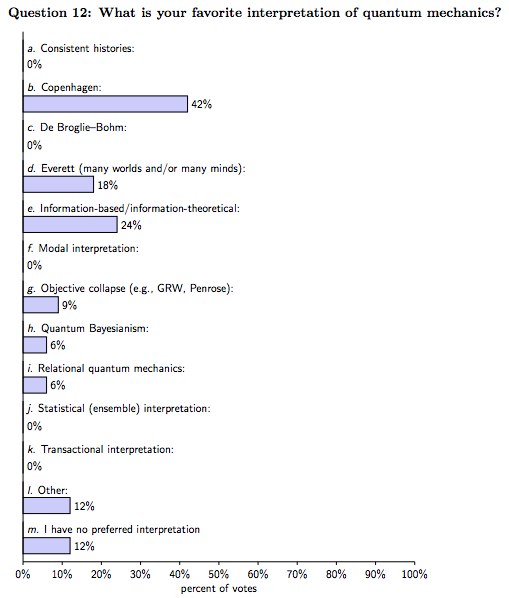
https://arxiv.org/abs/1301.1069
Effectively there is no current consensus on the issue, though Many Worlds and String Theory are widely regarded outside their adherents as non-falsifiable and therefore not legitimate theories.
Essentially the proponents of the theory have created beautiful math that fit their view, but absolutely nothing in the real world that can show that it is a more valid theory than any of the other theories which have equally elegant math to back them.
I don’t understand how it’s any more outlandish than thinking that we can be aware of everything that exists, or that everything exists in a straight line through time, never branching. Maybe it’s a lack of understanding on my part, but it seems the sum total of what we have discovered through science, or even through imagination, only illuminates a very small subset of reality. We can only measure with the instruments we can imagine and build, and with our own limited senses. So I wouldn’t jump to believe, nor to label unbelievable.
This was mentioned (not fully, but enough to get some of the ideas) recently in an episode of PBS Space Time
As far as MWI itself, my understanding is that it comes from simply taking the same math that works for atoms (as you say) and applying it to everything - the observers of a quantum system, the earth, the whole universe. I think it really comes down to the question: If Everything is a wave function, what would it look like from the inside? And MWI pops out of trying to answer that.
And the other interpretations of quantum mechanics don’t even seem better to me, requiring arbitrary conditions for a state to collapse to a single value for example. That feels to me like an entity of the type Occam meant.
Many Worlds isn’t taken seriously because there’s “proof” of other universes - it’s taken seriously because it’s actually the simplest explanation mathematically. The equations of quantum mechanics naturally lead to superpositions (particles existing in multiple states). MWI just says “what if we don’t add extra rules to make those superpositions collapse?” It’s like if you have a math equation that gives you 5 answers, and instead of creating a complicated rule to pick just one answer, you just accept all 5. Thats why physisists consider it - parsimony.
None. There is absolutely no proof of many worlds or the multiverse. RE the god of the gaps. It’s much more interesting to do physics rather than speculate about what falls outside the purview of the scientific method.
None.
It is, however, actually simpler than other theories, in that if you just let quantum mechanics do it’s thing without extra (unknown) parts to limit it, it produces many worlds. So, by Occam’s razor…
Specifically:
Quantum systems are in more than one classical state at a time, unavoidably. You can see this in the double slit experiment. Even if you send a single particle at a time through the slits, it passes through both and creates the interference pattern. (There’s also ways to formally prove that making quantum mechanics normal would require fate, or faster-than-light trickery which would actually be worse than fate)
Early physicists were very confused by this. The Schrodinger’s cat was used as a thought experiment meant to illustrate how that’s absurd, and it was decided there must be something that causes quantum states to “collapse” to one state before they can cause any trouble.
That’s not definitely wrong, and it’s still debated in versions by modern theorists, but it turned out not to be necessary. The reason for that is that if a part of a quantum system becomes entangled with something outside of it, the interference will no longer happen, and it becomes indistinguishable from multiple slightly different copies of the same system.
deleted by creator
Per rule 9, could you provide a source for your interpretation of the double slit experiment, specifically that “there is no sort of wave collapse” and “the photons absorbed by film or eyes were just not impacting the surface because they were absorbed elsewhere, causing less friction between the photons and changing the patterns on the surface.”?
This appears contradictory to the standard quantum mechanical explanation for the interference pattern, which is that the wavefunction of the photons passes through both slits, interfering with itself and changing the probability of detection or interaction at specific points along the film/sensor.
The effect isn’t unique to photons and has been observed with electrons, atoms, and even large molecules. As long as the slit size and spacing are comparable to the wavelength of the particle wavefunction it’ll work.
The photon wavefunction being a superposition of position states that self-interact, and then collapse into a single state/location when interacting with a non-quantum object are fundamental to quantum mechanics, and are part of the reason this experiment is such a great introduction to QM. The many worlds interpretation of wavefunction collapse is not fundamental- it’s one of many interpretations for what the math of QM means and not even the most popular amongst theorists (that’d be the Copenhagen Interpretation).
No, it’s not. Exactly one photon (or electron) still arrives. You can refer to Wikipedia for this one. And refer to the no-go theorems if you’re trying to push a homebrew hidden variable theory.
The Schrodinger thought experiment was intended to point out the ridiculousness of observation theory being applied in quantum theory, not an attempt to prove it.
Yes, which is why they had to come up with collapse, and later multiple worlds theory. Just not doing QM isn’t an option.
deleted by creator
Okay, cool, whatever. Maybe go write a paper about that. I’ll even read it so you don’t have to bother actual peer reviewers.
The “many worlds interpretation of quantum mechanics” is loosely that when you do a quantum coin flip, the universe splits into two universes, one for each result.
The reason for this thought is when you work with quantum mechanics, your system has a state that evolves smoothly, but if you “measure” it, the state suddenly snaps to (a random) one of the possible measurement values (when the coin isn’t being observed, it smoothly evolves, but once you measure it, it suddenly takes on a random value). However, if you expand your quantum description of the system to include your measurement device as well as the quantum “coin”, that sudden “snapping” goes away. Instead your whole system smoothly evolves, and it evolves into a “superposition” of the shared state of the state of the overall system in each of the possible measurement outcomes.
Extending this idea, it would seem that whenever you could describe a situation that acts like a “quantum coin flip”, both results happen, and the universe “splits”.
I really want to emphasize that the practical meaning of these “other worlds” is just that things are a lot “fuzzier” when you zoom in than classical statistics would suggest. Not that there’s another universe where you stayed with your ex or took a different career path or whatever.
Also this is an “interpretation” of quantum mechanics for good reason. It doesn’t really have any physical implications. In particular, it’s not possible to go “interact with” those “other universes”.
Most importantly, there are other “interpretations” of quantum mechanics, like that quantum mechanics is really a rethinking of statistics not of physics.
deleted by creator
Saw it in the MCU, has to be true.
I had a though experience years ago on mushrooms, that our universe lives in a blackhole. Just think about it, when stars big enough implodes it creates a black hole in the fabric of space, where nothing can escape (not even light).
The beginning of our universe is somehow related to a condensed hot/light that explodes and creates the actual expansion we see right now… Kinda curious right?
Also there’s somehow a limit how far we can see through our universe, that’s also odd… It’s impossible at the moment to see outside our own universe, because remember nothing can escape outside a blackhole, not even light !! Soo yeaah that’s why I think we live in a multiverse.
Also on a final note, Rick&Morty said so 🤷♂️
You’re kinda right, but not really. Based on a reductionist definition of a black hole, our universe is inside one.
However, that’s strictly based on some of the characteristics of a black hole, and our universe.
However, if we’re talking about black holes with more nuance, the answer becomes “no”.
I’m not qualified to answer this, but I happen to know someone with a PhD in astrophysics, who has published multiple articles about black holes. We’ve talked about this before and long story short: we don’t live inside a black hole.
The big bang theory disproves it. The existence of background cosmic radiation doesn’t match the interior of a black hole; it’s geometrically impossible.
Our universes ever growing horizon is out of limits, and we can’t escape from it. That’s not the sane thing as an event horizon though.
Just a correction, there isn’t anything limiting how “far” we can see our into the universe except our limited technology. And even then we are very close. We’re only limited by how old our universe is, as it takes light that long to travel to us from the edge of the expanding universe. The furthest we can possibly see would be about 300,000 years after the big bang, when light was finally able to travel unimpeded throughout the universe.
Thats way I said “for the moment”, because I know we are limited by our technology. However, even If our technology evolves to a degree so large we can not comprehend, I’m pretty sure we wouldn’t be able to “see” outside our own universe.
Sorry If my wording is a bit janky and not very scientific. Following your guts is also not very scientific in anyway, but that’s how I feel when seeing all those strange coincidence that cross each other strangely enough !
But thanks for the clarification !
Edit: Even if we can’t see outside our own bubblrle, we will still be able to travel from one universe to another :p
If we take the Schwartzchild Cosmology at face value we would only ever be able to “pierce the veil” through the boundaries of our cosmos with information/radiation through the Hawking Radiation, at least if the universe containing our local singularity has similar physics at play regarding singularities and the force of gravity.
That said, you could always go “down-well” into a singularity in our universe, but surviving the event horizon as more than particle soup spaghetti is quite a challenge.
This theory is called Schwarzschild Cosmology, and has actually gained some traction recently based on some new experiments.
https://journals.aps.org/prd/abstract/10.1103/PhysRevD.111.103537
As a youth this made intuitive sense to me as I first learned about different cosmological theorems. A black hole is essentially a pocket of mass on which a set of physical properties exist that are different from its containing universe, with the boundary between different physics being the event horizon and the “Big Bang” being the initial collapse of the singularity.