The idea is the land belongs to everyone, and each is entitled to make use of their fair share of it by simple virtue of being human. You wouldn’t “own” your home in such a society, merely be the current inhabitant of it. If you are familiar with these legal concepts, think of the entirety of humanity having naked ownership of the entire planet, and people having usufruct of what they can actually use.
An example that might help clarify: imagine a trucker working for a logistics company that lends her a truck for long hauls. This trucker might tell people “yeah, it’s my truck” in that she drives it and maintains it and sleeps in it and uses it all the time. Yet legally speaking, the truck belong to the company, which itself belongs to its shareholders — people who might not even have ever seen the truck in question, and only care for the profits it might bring through the work performed with it. One is ownership through usage and the other the current legal concept of propriety; they are in fact quite different.
People coming to your home and changing stuff without your agreement wouldn’t be OK since the freedom of one person stops where that of another begins. How that would be enforced is a an open question — left-anarchism advocates organization without hierarchy, which means it would be possible to form citizen courts and militias, which might belong to a federation for nation-wide or world-wide coordination without a state body. But we should remember the main point of all this however is to remove the main reasons theft is a thing in the first place (along with rectifying the greatest theft of all time), so it can be questioned how much enforcement would be necessary. Certainly not to the current extent where society must bear the weight of the state maintaining a land registry, escrow officers, dedicated justice system, police force, and army to defend it all.
These concepts of “fair share” and deserving of material wealth by mere existence are very weak or absent in our current system, which is built on the core idea that only immaterial things (rights) are granted by default to everyone, and material wealth is only acquired through contracts (work, inheritance, purchase — all these from people who do have all the material wealth one seeks).
You are correct in pointing out that, without a critical mass of adherents, left-anarchism cannot function. However this simply means that rather than being an ideology imposed from above by politicians, it is one that must be adopted by actual people. For this reason left-anarchists usually believe in contributing to local free associations (not necessarily political), promoting horizontal organization there through example, and therefore building a “revolution” from the bottom up rather than from the top down as advocated by some leftist groups.
I appreciate the admission that how to prevent rule violations isn’t fully set in stone yet. I’ve heard a lot of people try to argue for anarchist stances without giving an honest answer about that.
It’s definitely tricky. I spent some time in an Occupy camp when that was going on, and the way they functioned was anarchist. Daily meetings were held where everyone could speak and vote on rules, and we were actively encouraged to ensure that a diversity of viewpoints were addressed, ie if it’s your turn to speak and you notice that the last few people were all of the same race/gender/age range/etc., you were to choose someone who wasn’t part of that group to say their share next. This was to prevent any one group from overpowering the others. It required a lot of cooperation.
The problem was, some people didn’t care what was said in those meetings. They either didn’t attend, didn’t speak up, or didn’t care at all. I ended up leaving the camp after a guy wouldn’t stop smoking wherever he felt like. There were children, asthmatic people, and others who were sensitive to smoke participating, and as a group we decided to reserve some areas for smoking. I even used my work discount to get some buckets and sand to create ashtrays for those spots.
But this one guy, a self-professed libertarian, ignored all the rules. He didn’t care that tents are breezy and if someone smokes outside them, they’re basically getting fumigated. I spoke up, my partner spoke up, others spoke up, but nothing happened. There simply wasn’t any way to enforce the rule or kick the guy out. I commuted to work every day I was there, and thanks to this guy I ended up with raging headaches because I inadvertently breathed second-hand smoke all night. Eventually I just couldn’t take it anymore, and that’s when I left the camp for good.


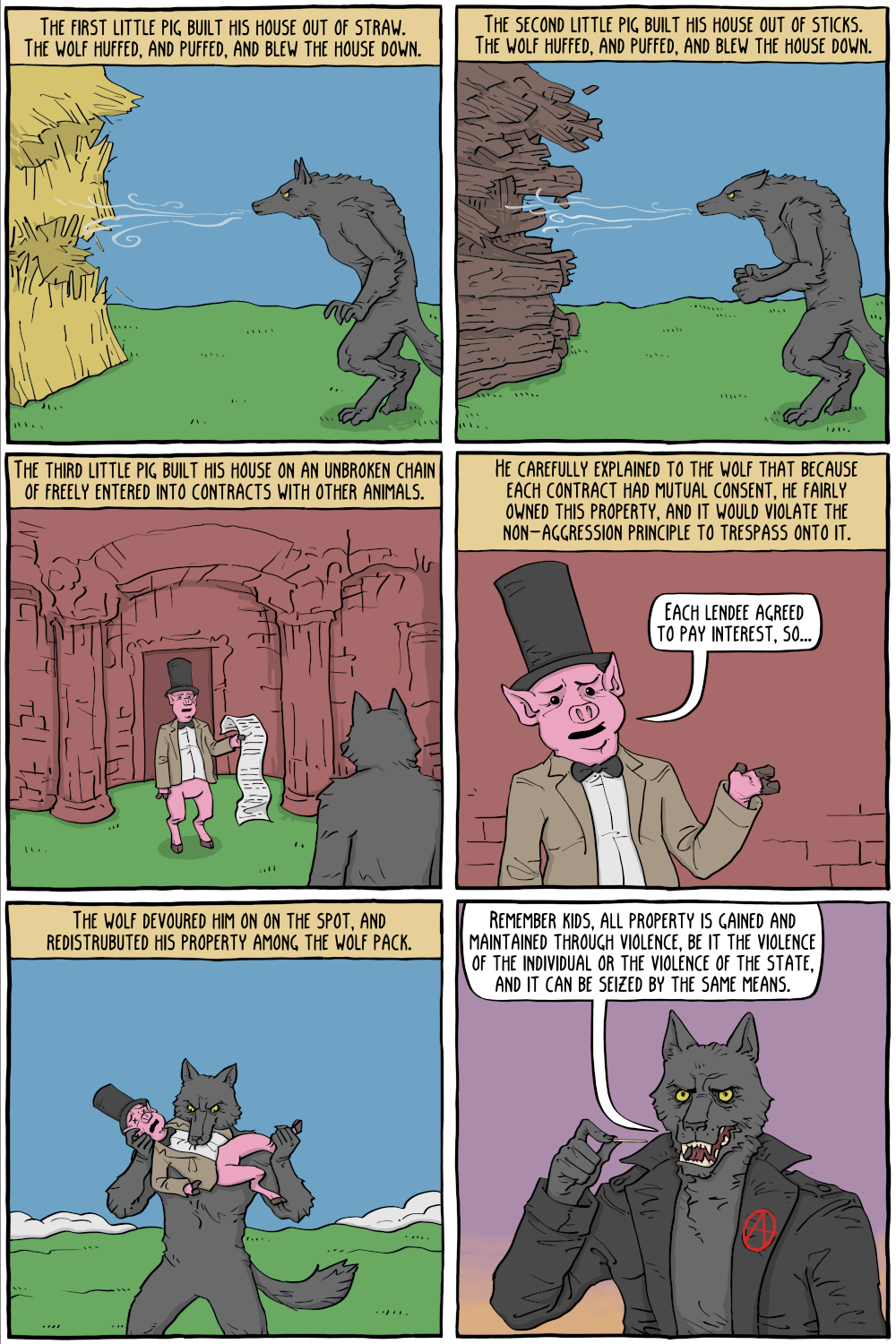
The idea is the land belongs to everyone, and each is entitled to make use of their fair share of it by simple virtue of being human. You wouldn’t “own” your home in such a society, merely be the current inhabitant of it. If you are familiar with these legal concepts, think of the entirety of humanity having naked ownership of the entire planet, and people having usufruct of what they can actually use.
An example that might help clarify: imagine a trucker working for a logistics company that lends her a truck for long hauls. This trucker might tell people “yeah, it’s my truck” in that she drives it and maintains it and sleeps in it and uses it all the time. Yet legally speaking, the truck belong to the company, which itself belongs to its shareholders — people who might not even have ever seen the truck in question, and only care for the profits it might bring through the work performed with it. One is ownership through usage and the other the current legal concept of propriety; they are in fact quite different.
People coming to your home and changing stuff without your agreement wouldn’t be OK since the freedom of one person stops where that of another begins. How that would be enforced is a an open question — left-anarchism advocates organization without hierarchy, which means it would be possible to form citizen courts and militias, which might belong to a federation for nation-wide or world-wide coordination without a state body. But we should remember the main point of all this however is to remove the main reasons theft is a thing in the first place (along with rectifying the greatest theft of all time), so it can be questioned how much enforcement would be necessary. Certainly not to the current extent where society must bear the weight of the state maintaining a land registry, escrow officers, dedicated justice system, police force, and army to defend it all.
These concepts of “fair share” and deserving of material wealth by mere existence are very weak or absent in our current system, which is built on the core idea that only immaterial things (rights) are granted by default to everyone, and material wealth is only acquired through contracts (work, inheritance, purchase — all these from people who do have all the material wealth one seeks).
You are correct in pointing out that, without a critical mass of adherents, left-anarchism cannot function. However this simply means that rather than being an ideology imposed from above by politicians, it is one that must be adopted by actual people. For this reason left-anarchists usually believe in contributing to local free associations (not necessarily political), promoting horizontal organization there through example, and therefore building a “revolution” from the bottom up rather than from the top down as advocated by some leftist groups.
I appreciate the admission that how to prevent rule violations isn’t fully set in stone yet. I’ve heard a lot of people try to argue for anarchist stances without giving an honest answer about that.
It’s definitely tricky. I spent some time in an Occupy camp when that was going on, and the way they functioned was anarchist. Daily meetings were held where everyone could speak and vote on rules, and we were actively encouraged to ensure that a diversity of viewpoints were addressed, ie if it’s your turn to speak and you notice that the last few people were all of the same race/gender/age range/etc., you were to choose someone who wasn’t part of that group to say their share next. This was to prevent any one group from overpowering the others. It required a lot of cooperation.
The problem was, some people didn’t care what was said in those meetings. They either didn’t attend, didn’t speak up, or didn’t care at all. I ended up leaving the camp after a guy wouldn’t stop smoking wherever he felt like. There were children, asthmatic people, and others who were sensitive to smoke participating, and as a group we decided to reserve some areas for smoking. I even used my work discount to get some buckets and sand to create ashtrays for those spots.
But this one guy, a self-professed libertarian, ignored all the rules. He didn’t care that tents are breezy and if someone smokes outside them, they’re basically getting fumigated. I spoke up, my partner spoke up, others spoke up, but nothing happened. There simply wasn’t any way to enforce the rule or kick the guy out. I commuted to work every day I was there, and thanks to this guy I ended up with raging headaches because I inadvertently breathed second-hand smoke all night. Eventually I just couldn’t take it anymore, and that’s when I left the camp for good.