

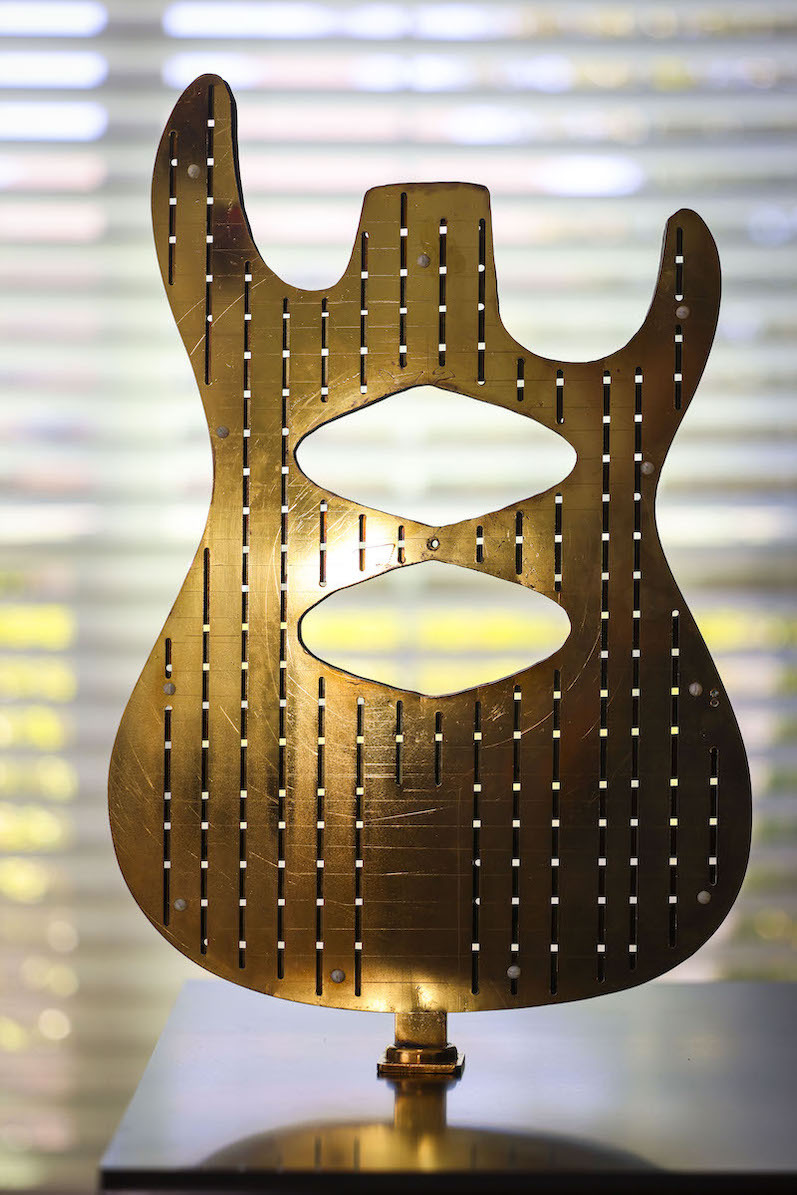
This is the first prototype photonic guitar. A photonic guitar works like an acoustic instrument but instead of the resonance of wood and acoustic vibrations it uses the resonance of electricity and electromagnetic waves (light). I first created this guitar as a design tool for electric guitars before I fully recognized the significance of the underlying physics. It wasn’t just like a guitar, it is a guitar. I suspect some people reading this don’t believe me but that’s ok, neither did my old physics grad school at first. Same with the patent office. I’ve linked an article about me from the Dallas Morning News.
While the photonic guitar produces music it doesn’t produce sounds. The waves it creates are electromagnetic (light). While electric guitars match the same frequency as an acoustic guitar, the photonic guitar matches the same physical wave size. So the 20 Hz - 20 kHz audible range is equivalent to 20 MHz - 20 GHz. We can’t see those waves either. So I created a guitar plugin, a physics based model for the photonic guitar driven by measurements, to recreate and apply the photonic musical effect to electric guitars.
For years I could only wonder what the photonic guitar was going to sound like. From physics I would argue it would have properties of an acoustic guitar. Both systems satisfy the wave equation and have the same boundary conditions. In practice I’m most surprised by the impact it has on distortion, noise, and feed forward. Feed forward is analogous to feedback but doesn’t require holding the guitar up to the amp speaker. That and the fact that the guitar itself can produce a delay effect. I’ve linked to one of my favorite demos so far.
Can you describe how one physically ‘plays’ this instrument? Or better yet, upload a video of someone doing so?
For example, one plays a guitar (or any stringed instrument) by vibrating a string at different lengths to achieve different pitches. Most instruments’ bodies are hollow to provide a natural resonator so we can hear it. Electric variants don’t have to follow this, since the vibrations are picked up by magnets and amplified externally, although the vibration of a solid body stringed instrument still counts for a ton of the tone and sustain.
What is the equivalent description of your instrument? Where does one put ones hands to play it, and how is the sound produced?
The equivalent string for a photonic guitar is a wire, or coaxial cable. Different lengths of the cables would produce different pitches. Rather than a mechanical vibration it is electrical. The photonic guitar body is also hollow and would resonate electrically like an acoustic. The photonic guitar doesn’t make sounds though. The waves are electromagnetic. Because of the different physics the photonic guitar has to be played a million times faster than standard. So in practice the photonic guitar is easiest to play using technology, more like a guitar pedal. It is possible to create more direct ways to play the instrument but that requires kore resources to develop. I hope to pursue those though if and when the current plugin is successful in the market.
OK so when you are uploading demos of your device, are you simply sending a previous recording of a normal guitar through it? Or if not how does a musician ‘play’ the instrument to produce these sounds?
We use an electric guitar recording that runs through a photonic guitar plugin that runs on iOS. Can also be played live of course.