- cross-posted to:
- aboringdystopia@lemmy.world
- cross-posted to:
- aboringdystopia@lemmy.world
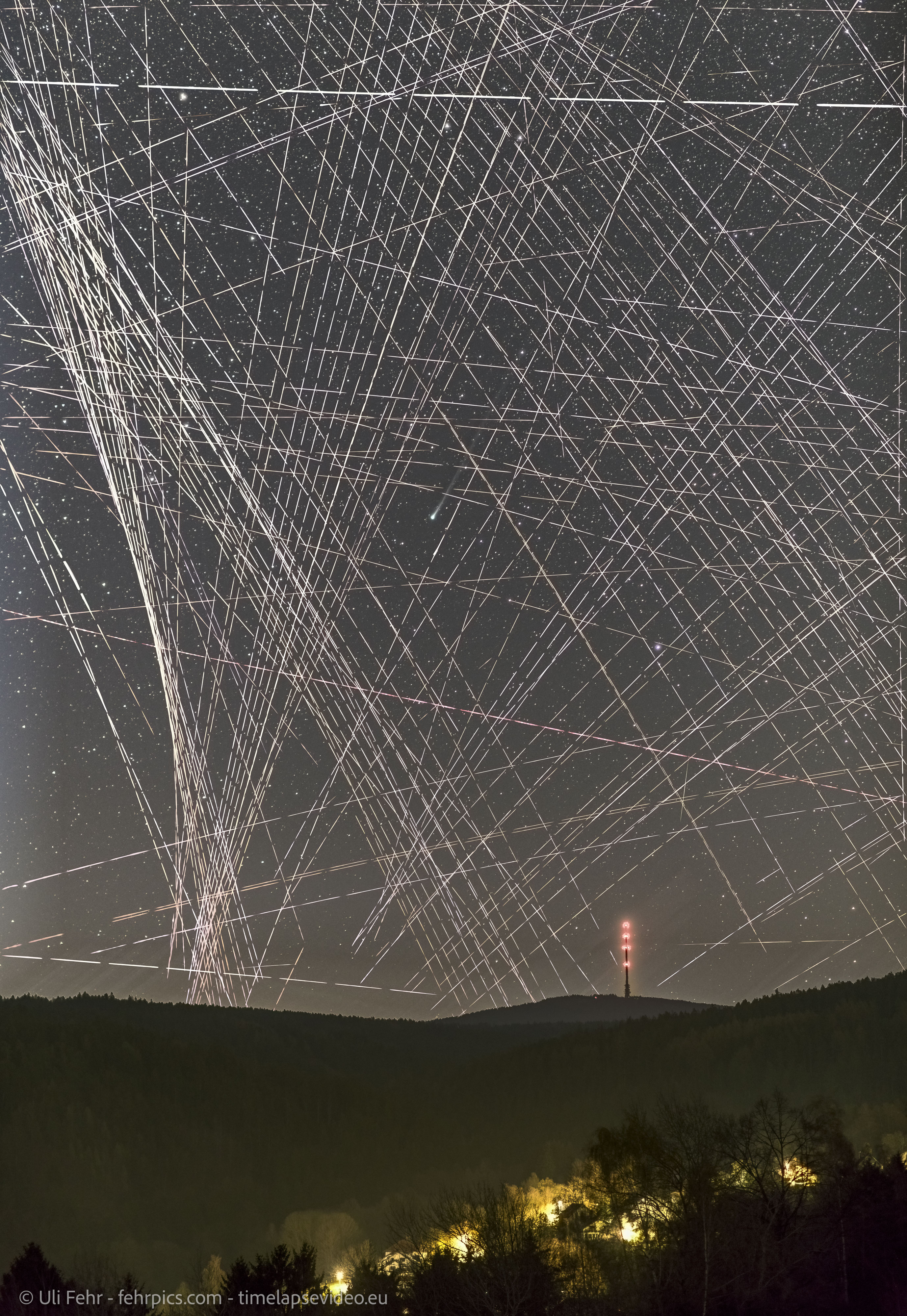
Can you find the comet? Somewhere through this web of satellite trails is Comet C/2025 R3 (PanSTARRS), a bright visitor passing through the inner Solar System. Now, the orbiting satellites themselves only appear as streaks because of the long camera exposure, over 10 minutes in this case. On the contrary, to the eye, satellites appear as points that drift slowly across the night sky and shine by reflecting sunlight – primarily just after sunset and before sunrise. The featured image was taken just before sunrise two weeks ago from Bavaria, Germany. Presently, Comet R3 PanSTARRS is hard to see for even another reason – because it is so (angularly) close to the Sun. As the comet rounds the Sun, it will be best seen in coming weeks from southern hemispheree skies, although then it will be heading out to interstellar space and fading. If you haven’t yet found the comet, don’t despair; please take a closer look just above the image center.
You must log in or # to comment.
@Innerworld this is what our sky looks like after it was hijacked by tech billionaires.
They stole the skies from us.
Captain Reynolds even couldn’t imagine this dystopia.
Thanks fElon Musk. Way to ruin the fucking night sky.
why are the satellite trails segmented?
Speculation:
One way of doing astro time-lapses with digital cameras is to combine many short-ish exposures in post. Fast-moving objects (when I tried this, ships and planes) can show up as segmented trails, because they move significantly during the brief interval between exposures.
The fast moving nature also makes them trivial to filter out of the final image.
Essentially every stacking program have options to reject outlier pixels, such as the satellites. Hell even just averaging the pixels in an image stack without the outlier rejection would greatly diminish the streaks.
It looks like they stacked the images by taking the maximum pixel values; any other method should’ve produced much fainter or nonexistent trails. A good way to show just how many satellites there are, but not a realistic depiction of their effect on astrophotography.
got it, thanks.