

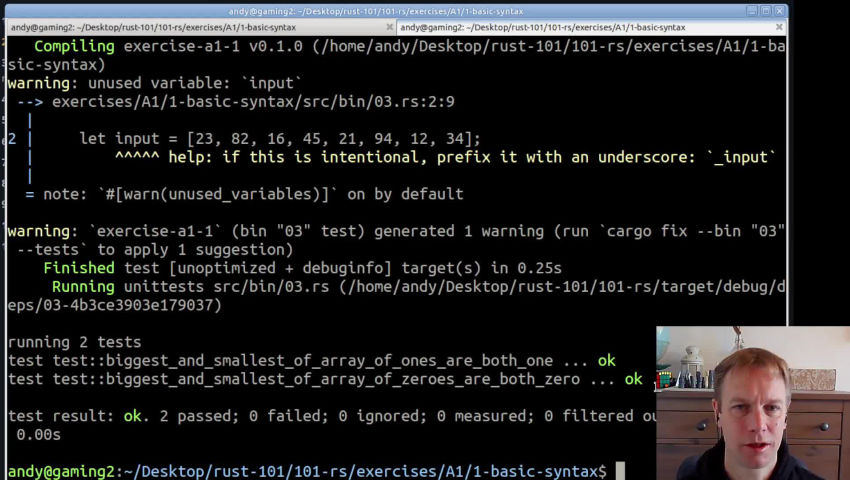
cross-posted from: https://diode.zone/videos/watch/9766d1f1-6018-48ec-ad67-e971758f8a3a
Going through some exercises on basic Rust syntax and ownership.
Links:
Exercises: https://101-rs.tweede.golf/A1-language-basics/mod.html
Slides: http://artificialworlds.net/presentations/rust-101/A1-intro-to-rust
Rust 101 is a series of videos explaining how to write programs in Rust. The course materials for this series are developed by tweede golf. You can find more information at https://github.com/tweedegolf/101-rs and you can sponsor the work at https://github.com/sponsors/tweedegolf . They are released under the Creative Commons Attribution Share Alike 4.0 International license.
This series of videos is copyright 2023 Andy Balaam and the tweede golf contributors and is released under the Creative Commons Attribution Share Alike 4.0 International license.
These videos are roughly on track with the Reading Club apparently, so this video belongs here this week, I think.
I think I have some answers for you if you haven’t resolved them yet:
voidfrom java- and c-style languages. Here is a decent explanation on StackOverflow if you prefer that sort of thing.println!("{}", multiply(10, 20));And “sadly” (for us here), this doesn’t explicitly say “I am expecting an int/i32 as output of
multiply”, it only says “I am expecting something that implements theDisplaytrait”. I think that in such cases it defaults to assuming the unit type()because it is the “simplest”/“most conservative” guess the compiler can make in such cases.Thanks!! Very helpful!
I found a more precise answer re: type inference: https://stackoverflow.com/questions/24977365/differences-in-type-inference-for-closures-and-functions-in-rust
As I understand it, if a function is public you will need to explicit the return type. If it’s private/local/not visible from outside the module wherein it is defined, then inference can kick in.
But generally, you’ll want to specify the return type to make the compiler that much more aware of your intent.
That makes a lot of sense. Intuitively I figured it would be something like that.
Still, as a compilation error, it’s confusing to see an error on the unit type being inconsistent when the issue is really an untyped return. Though now I know what the unit type is it’s a bit clearer what such a compiler error is about.
deleted by creator
I’m not so sure that this is the issue. I understood that blocks are expressions. The issue was that I didn’t know that type inference doesn’t apply to function returns (generally). That such is not true is easy to guess, but I’d presumed as much because the task of inferring seemed no more difficult than local variable type inference.
And so given that it’s such a simple and essential requirement, I’m not sure it wouldn’t be simpler and better to have a compiler error that simply states that an explicit return type is required.
Seeing instead that the return type was understood to be the unit type is also confusing as the function block clearly had a return value (here, AFAIU, explicit/implicit return makes no difference). So instead of wondering about the need for an explicit return type I immediately wondered about what type the function was actually returning (ie, had I accidentally created
()).Of course I didn’t know about the unit type etc. But even so, as a compiler error, it’s represented in pieces rather than cutting to the core requirement of an explicit return type. Perhaps a reminder better left to a linter. I’d guess clippy warns you about this, but I thought I’d just rely on the compiler for as long as I can.