Beyond Power Voltra https://youtu.be/6iaeTJzXBV8?t=100
That 70 pound concentric with 200 pound eccentric combo setting was hilarious!
Beyond Power Voltra https://youtu.be/6iaeTJzXBV8?t=100
That 70 pound concentric with 200 pound eccentric combo setting was hilarious!
deleted by creator
This youtube comment is gold! 😂
Tried this and the guys at the gym told me I’m rowing wrong lmao


In some ways, heavy weights stay heavy. After all, dropping a 20 lb dumbbell on your foot still hurts even if it doesn’t feel like any weight while you lift it.
Thanks for explicitly mentioning this! It jogged a memory of a stupid habit where after I finish my 3rd rep on heavy shoulder dumbbell presses, I lazily “slam” the dumbbells onto my legs (habitually) because they are rubber and the 40’s and 45’s don’t hurt when I do that. But the 55lb & 60lb dumbbells actually hurt significantly compared to the 45’s and the 55/60’s leave bruises because I’m so focused on slow eccentric that I mentally “clock out” and just drop the weights onto my lap before racking them and exhale a victory sigh. It reminds me of the death 10 months ago of an extremely reputed climber 23yo Balin Miller who finished his dangerous climb of El-Capitan but died 5 minutes later while descending 20 feet to retrieve his chalk bag because he forgot to tie off his belay during a TikTok livestream. In other words, he declared the feat “completed/finished” in his mind before it actually was.
I believe you helped me solve the mystery and in fact, the fear/dread is my brain reminding me not to do that with the 55lb & 60lb dumbbells… 🤦♂️ This also aligns with the “unable to properly celebrate improving my PR by adding another rep” mentioned in the OP because that’s actually where I recently noticed the negative emotion most acutely and I felt robbed of the wave/rush of happiness/excitement you get from besting your PR on your favorite lift.
A big insight I realized after posting today is how ubiquitous the 45lb plates are at gyms everywhere and that I carry them extremely frequently at my gym. I think that my brain is comparing everything to that standardized weight because even the 50’s have a modicum of that fear/dread and it just so happens to be one size larger than the 45lb plates.
Tomorrow I will try to remind my brain that the 55lb dumbbells weigh significantly more than the 45lb plates and see if that “solves” the problem. For the past 2 years, I’ve plausibly been training my brain (incorrectly) that all the dumbbells weigh less than or equal to the 45lb plates. 🤦♂️

, I once read a Cowbee post
Did you bookmark the link, by any chance?
A trick I use when deciding between closely balanced possibilities is to flip a coin. If you immediately think to yourself I wanted the other side, switch. Job done.
This is brilliant! Did you come up with this idea?
Understood. I had written a draft 1-2 months ago (that was eaten by my browser and I lost it) and was going to make a post about RIR because I’ve slowly lost faith in that idea. Here was a reddit screenshot I planned to include in the post:  https://i.imgur.com/R2sf6pO.png (posting twice in case one version is unreadable)
In summary, the 1 line from this person’s reddit screenshot that summarizes perfectly what I believe about RIR is that “it has way too much to do with one’s personality” and I would also add that I believe it has to do with someone’s preparation. I spend a massive amount of effort in life ensuring that each day at the gym, I am brimming with energy similarly to this guy right before his Zercher deadlift: https://youtu.be/BAb4TRPVo8w?t=11
I respect the idea of the RIR and I believe it has value and usefulness, but I also believe it arbitrarily shifts locus of control away from the person and gives the person an excuse at the gym to arrive less prepared to the gym. Lastly, it diminishes those with an inherent (or cultivated) extremely strong “David Goggins” style of personality who have massively greater ability to “recruit effort” from the brain before/during the brain’s recruitment of motor units.
Furthermore, I believe that the Grease-The-Groove protocol indirectly teaches a person to get better at recruiting effort and sharpening their personality to be more like peak David Goggins. I could be wrong though, I’m still just a beginner but one who has tremendous fascination with the physiology & neurology involved with peak strength and/or peak gym performance.
(from my OP) My favorite fitness youtuber last year was “Flow High Performance” and I believed his advice (and 90% of other fitness youtubers) emphasizing the RIR advice that essentially says to make sure all your working sets are limited to 3 or fewer reps in reserve.
I apologize for the poor communication. I was a fan of the RIR advice last year but not this year. My wording was terrible and I should have been more clear.
I am now a fan of the “Grease the Groove” technique/advice which says to do a heavy percentage of your 1-rep max but only do fewer reps with much longer rest times. Pavel says to do 3 reps of whatever weight represents your 6-rep-max but other youtubers have slightly different recommendations for calculating how much weight to use and how many reps.
Technically I’m no longer following the “grease the groove” when I switched from 50 to 55 pound dumbbells but I felt the 50 pound dumbbells were too easy and I was compensating by doing multiple sets, which I feared may have been contributing to my systemic and/or neural fatigue, which is my current bottleneck that I must figure out a solution to.
However after writing this, I now realize I am doing multiple sets per day with the 55 pound dumbbells which I promised myself I wouldn’t do, thus negating the initial reason for switching from 50 to 55 pound dumbbells. 🤦♂️
It’s not deeply insightful imo beyond telling you what you’re doing now compared to what you’ve done before. Are you doing more than before? If so, good, that’s supposed to happen. If not, why?
Yes. In December I could not lift the 50 pound dumbbells for 1 rep. I could only get 45 pound dumbbells for 4 reps and failed with the 50 pounders.
Question for you: I rarely see or hear about people doing 3 rep max or 1 rep max with dumbells, usually that is a barbell thing? Why aren’t you doing more like the 6-12 rep range?
My favorite fitness youtuber last year was “Flow High Performance” and I believed his advice (and 90% of other fitness youtubers) emphasizing the RIR advice that essentially says to make sure all your working sets are limited to 3 or fewer reps in reserve. I stumbled across a different concept (the greasing the groove protocol) and I tested it experimentally and had superior results compared to my workouts last year. Here’s a playlist of 9 videos I put together and the linked video summarizes it pretty well (i.e. that “less is more”): https://www.youtube.com/watch?v=WtU66OYkJIE&list=PLCh9kW9pX73Z9O4ya7PVfId9XOUQZ-_a5&index=2
The main reason though is because I like it. I love going to the gym and doing 15 seconds of high-intensity effort (sets of 3) and then resting for 10 minutes by setting a timer, logging my exercise, figuring out which exercise I want to do next, looking at my exercises the past 3 days to see if a muscle group hasn’t been targeted, etc…
I love the ratio of 15 seconds to 600 seconds of work/rest. It fits my personality and my preferences and is the setup I find most enjoyable. But it also seemingly works better than the most recommended method by youtubers such as Jeff Nippard, Mike Israetel, etc…
Also, there’s a good reason it is not recommended to do heavy compound lifts every day, like you said you’ve been doing. Has that worked well for you? You will probably advance more quickly by lifting less frequently! Rest/recovery is just as important as the lift, as it’s where the muscle actually grows and gets stronger.
Fully agreed! I’m still a beginner and I’m trying to learn how much each exercise contributes to neural or systemic fatigue as that’s my limiting factor. I was somewhat “forced” near the end of last month to take 4 days off from the gym due to life responsibilities, and it made me realize I was severely under-resting and neglecting my recovery by a huge margin. I was looking at my average daily volume of 10-20 reps and believed it was extremely low compared to other programs I’ve looked at (such as Jeff Nippard’s 7 day split of Push, Pull, Legs, rest, upper, lower, rest) and I thought doing 3-6 working sets per day would never give me more fatigue than I could recover from by the next day. Suffice to say, I was very very wrong. 🤦♂️
So your decision for an activity over the next decade or so depends on whether some strangers would label it as a hobby or part of cooking?
It is my (admittedly terrible) attempt at due diligence and kicking the tires on a new hobby before investing time & money. I bought a violin last year and only practiced twice last year and twice this year. But I bought my niece the same violin last month and have offered to teach her. She loves violin and this gambit seems successful so far at forcing me to learn enough to show her easy songs on violin (Twinkle Twinkle litter star, etc…) which I can barely play myself but she doesn’t know any better, lol.
Amazing response, thank you!!! I’m watching the video now and will follow all these suggestions.
So I’m not in Florida, but I am in the tropics. But we do have similar challenges, and I’ll use Florida growers if I’m looking for something.
This video would be a good review, but I’m sure you’ve already done this level of research.
https://inv.nadeko.net/watch?v=vpMtjNVGfJQ
A few things I can start you with, some are going to be specific to tomatoes, some are going to be just general growing tips.
First, we want to separate out few things.
Starting plants and getting healthy starts is a skill all unto itself. Its why I don’t recommend people starting with seeds if they are just getting started. There is no shame in just going to a garden center and buying a few starts, or even some established tomatoes. If you’ve struggled with a plant type before, this is a good starting point. Simplify the problem by making it smaller, and cutting out a very challenging step like starting and establishing the plants perfectly acceptable.
The best prevention of disease among any plants is health. A healthy plant can usually shrug off most things if its a strong and healthy plant to start with, which is another reason to buy a good quality start from a reputable grower. Not starting with healthy plants is not setting yourself up for success. It sounds like you’ve even keyed in on a few varieties. That’s great. The video I put up top also mentioned some other good varieties that do well in high heat and humidity.
We’re still really talking about health, but tomatoes are heavy, heavy feeders. And fertilization is key. Lots of nitrogen, tomatoes just eat it right up. To the point you can struggle to get fruit if you feed to heavily (at least too much N) but N is critical to getting them established and health.
Tomatoes need AIR and lots of it. Aggressive pruning of suckers and leaves to provide more airspace so that the area around the plants local leaf environment is less humid. This helps especially with fungal diseases. Also, avoid getting any soil on, or have any leaves touch the soil if soil borne diseases are an issue. The key to any commercial operation is sanitation. Commercial nurseries will scold you if you dont disinfect your tools between any interaction with plant tissue to the point that wiping them down becomes second nature. Fusarium wilt and vertiulum wilt are both soil borne diseases. Now maybe its in your soil, but if you live in an area with lots of ag, it could be soil getting blown onto where your tomatoes are planted. Here in Hawaii, its not fusarium, but a type of tropical fruit fly thats our biggest issue, and it attacks young growing fruits by laying its egg in them. Because of this we use mesh on our tomatoes and often bag the whole plant in a fine mesh. But this mesh can also prevent diseases that come from blow soil landing on their leaves.
After reading your case and responses, my suspicion, and I might be wrong, is that you are trying to do a lot, and would benefit from breaking the process down into smaller parts, and then just trying to do one part well (growing the tomatoes part). Don’t worry about starting the plants or hydroponics until you get some small successes overcoming these disease and health issues. Hydroponics won’t help if the actual issue is that your neighbor has some plant harboring the disease nearby, and just spores or dust is being blown in. I don’t want to be patronizing because I see and acknowledge you’ve already put a lot of effort into seeking success here.
What I would recommend is simplifying the problem down to the most basic possible case, and when that is working, then build up from that. 4 five gallon pots, and pick 4 varieties that are known to work in your environment. Buy fresh, bagged garden soil, not yard soil for this. Get established plants from a reputable grower. Cut out all the possible places it could go wrong.
I’ve only had success with cherry tomatoes. I can never grow full-sized tomatoes due to fusarium wilt and vertiulum wilt, even after spending dozens of hours watching youtube videos and reading forum posts and extension office newsletters on how to fix it. But I live in a rural area and there’s at least 5 massive tomato fields within 30 miles of where I live in Florida (by commercial growers) so it’s absolutely possible but I just don’t know their secret. 😣

I met another local gardener through an online board game but he was unable to offer advice on wilt disease prevention. Do you have any actionable advice on how to prevent fusarium wilt and/or verticulum wilt? I’m inexperienced with Lemmy so if you can’t view this screenshot easily, I’ve transcribed it below:
I had a gardening question if you grow tomatoes
I have tried about 12 different tomato cultivars (medium to large sized, for sandwich slicing) and they all die halfway into their life cycle due to the 2 common wilt diseases in Florida’s hot humid weather
My best attempt was with better boy hybrid but I only got about 8-10 tomatoes and they were not big & healthy but undersized due to the struggling plant
I can do fine with cherry tomatoes (supersweet 100s and Everglades tomatoes) but I’ve never been a successful tomato gardener and have tried all the tips such as well draining soil, mixing in compost, watering at the base so the leaves don’t get wet, etc…
I have not bothered with hydroponic soil-free substrate but I bought 2 giant boxes of it a few years ago and still have it (coco coir and perlite) but it seems too much ongoing effort even if I got 50 tomatoes or more per plant
I also bought 200 rockwool cubes and might consider starting them in soil-free substrate and then transplant them when they are a foot tall, so they have a head-start at dealing with wilt funguses
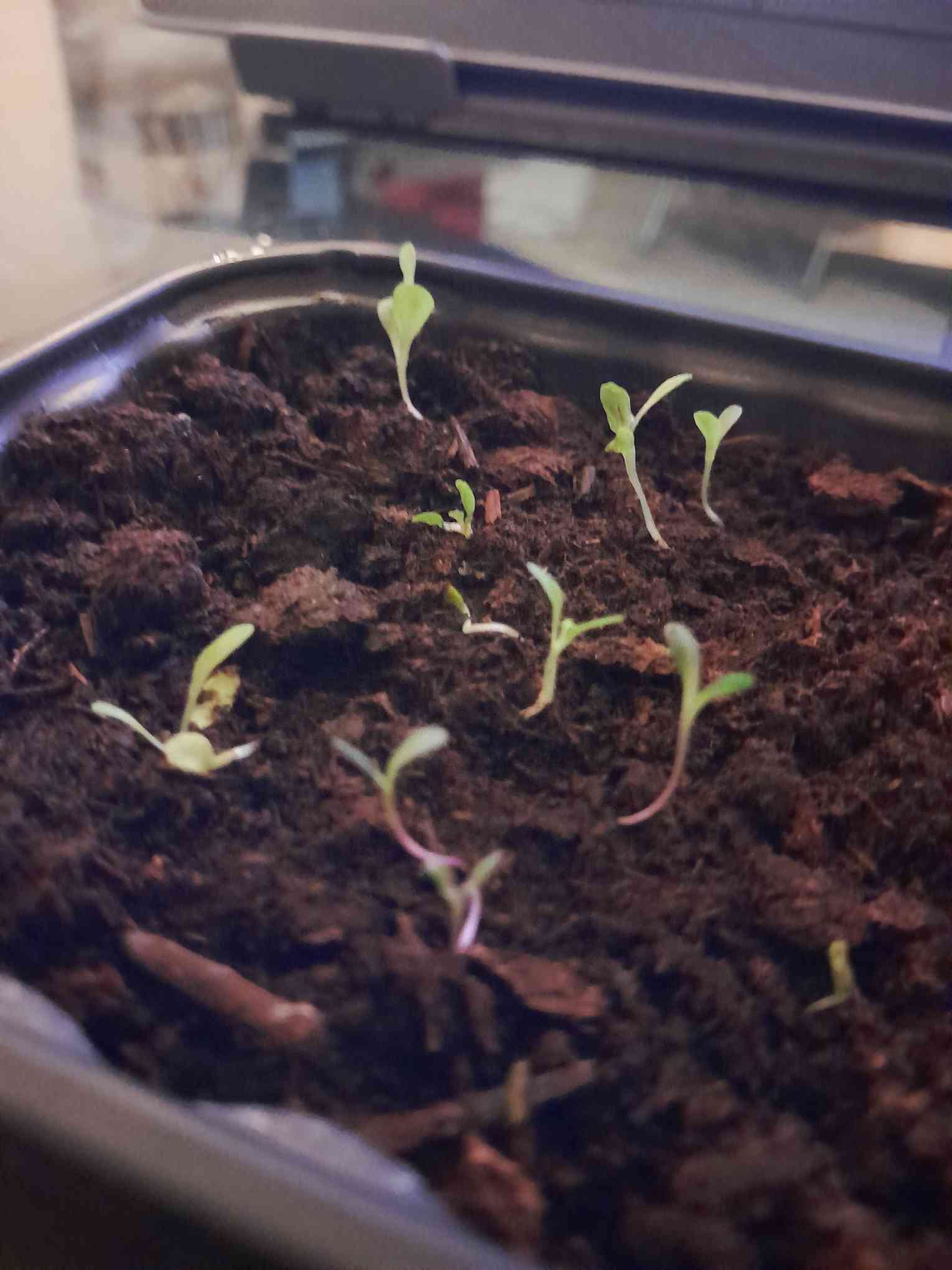
Those are rock wool cubes (for hydroponic gardening hobby) mentioned in the last paragraph with a nascent tomato plant growing in the lower left corner of the image. Whenever I feel motivated enough to start hydroponic gardening, I just shrug my shoulders and plant my tomato seeds or rosemary seeds conventionally in a flower pot. (I always manage to find an excuse at the last minute on the day I finally roll up my sleeves to start hydroponic gardening 🤦♂️)
If you or anyone has questions about first-time gardening, ask away!
I’m just trying to force myself to either start the beef jerky hobby this weekend or the hydroponic gardening. My excuse for not starting the beef jerky all year is not knowing whether it “counts” as a valid hobby, so this post will help me force myself to “shit or get off the pot” and pick one since inaction is the same as choosing “neither”.
I also own a virtually unused violin that I’ve only played 3-4 times this year which was my hobby I intended to begin last year. 🤦♂️
On the topic, whats important to you about a hobby versus a skill or technique?
I spent the first 30 years of my life in front of my computer. All my hobbies were computer or video game related. I also was immobile about 5 years ago (bedridden, over 400 pounds). It feels wasteful to not utilize my newfound mobility and do stuff outdoors. I can go back to all my old childhood hobbies when I’m old & senile.
Ngl, and I don’t think you are a bot, but this feels like one of those astroturfed askreddit questions that come from bots.
I have terrible social skills in real life, I guess that bled into my online persona too. 🤦♂️
That’s largely due to lack of mobility training. I would highly suggest making that one of your hobbies.
Already on it 💪



I’m fascinated by your knowledge of various fastening/affixing hardware (such as a shaft collar, which I didn’t know exists but can see its immense usefulness). Did you learn about all these devices from your job? If so, where does someone like me learn about all these various cheap metal apparatuses since I enjoy building my own stuff as it relates to my various hobbies, including but not limited to, climbing/fishing/beekeeping? This type of knowledge would be extremely useful if I can find out where to attain such knowledge! Just looking to be pointed in the right direction so I can get started more easily, such as maybe a couple keywords or search terms to lead me down a deep-dive rabbit hole.
This is chatGPT’s recommendations, if I don’t hear back I’ll just start with this list. 😁