


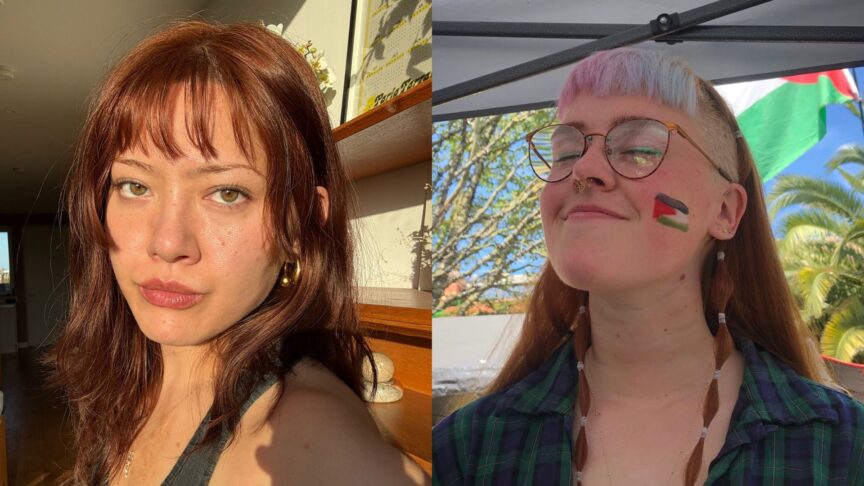
“They’re saying it’s so that I won’t radicalise anyone else, which is a bullshit excuse to alienate us from the world.”
This is Ellie Kamio speaking – a 30-year-old former nursery teacher and one of four Palestine Action activists sentenced as terrorists last month over a break-in at an Israeli-owned arms factory in 2024.
Ellie and one of her fellow defendants, Charlotte ‘Lottie’ Head, 29, spoke to Novara Media about what prison is like after being sentenced with a ‘terrorist connection’, despite not being convicted of a terror offence.
Ellie and Lottie are now subject to an enhanced contact vetting (ECV) scheme for “terrorist prisoners”, meaning their contact with the outside world is restricted to a maximum of 20 people, who all have to undergo vetting. Only these 20 people can call, email, write to or visit them. They spoke to Novara Media via one of their registered contacts.
Lottie, previously a charity worker supporting victims of domestic violence, called it a “further attempt to break and psychologically punish us” through isolation, and a move “to reduce our world yet further”.
Both women already spent 18 months in prison before their first trial – far beyond the standard legal custody time limit for unconvicted defendants of six months. In May they were found guilty of criminal damage for smashing up property, including military drones, at an Elbit Systems site in Filton, Gloucestershire.
Lottie stressed that the ECV vetting process can be intimidating for friends and family to go through, particularly due to fears around the potential impact on immigration status, work or simply “the worry of being caught in the crosshairs of the oppression we are experiencing”.
Ellie’s mum Emma Kamio told Novara Media that the ECV has led to some tough decisions – like Ellie deciding to drop her younger sister Sadie as one of her 20 contacts, because Sadie finds visiting prison too traumatic to do regularly. Now, Ellie can’t even speak to her sister on the phone.
Emma – a Swansea-based small business owner who was “traumatised” by her own brush with counterterrorism police in connection to Ellie’s case – added that there’s additional “pressure” on the 20 chosen contacts. “People are going to get tired”, she said, and life happens: they might go travelling, not be able to visit or not be available for phone calls. It becomes a real commitment, not for fair-weather friends.
Prison in a heatwave.
The word Ellie uses to describe prison is “neglect”. “I wouldn’t say ‘neglectful’ because it’s not only a place that neglects people, but also a place where neglected people go.”
Both Ellie and Lottie are currently incarcerated in HMP Bronzefield, on the outskirts of Ashford in Surrey. Inside, Ellie said, inmates are “dehumanised daily, multiple times a day” and “treated like dangerous animals, not human beings”. Examples are a recent dinner of a “plain jacket potato in a cup” and how “staff or officers will talk about you when you’re standing right there”.
On the issue of food, Emma said her daughter’s budget is mostly used in the canteen [prison shop], supplementing sub-par prison meals with vitamins and extras like nuts (Ellie is a vegetarian). Emma pointed out the irony of Bronzefield’s private owner, Sodexo, also being a food services and catering company.
Following soaring temperatures in June, Lottie said: “Prison in a heatwave is hell on earth. In Bronzefield, you cannot open the windows in your cell. This means that, with prisoners locked up for the vast majority of the day, there is no fresh air or way of dispelling heat from the cells.
“It truly highlights how staff see prisoners as ‘other’, sometimes even subhuman.”
When temperatures reached 34C in the south east at the end of June, Lottie said “our entire wing didn’t even have the paltry fans each cell is supposed to be furnished with” and prisoners were “forbidden from wearing shorts more than one inch above the knee or vests with thin straps”. The UK has since experienced another, longer heatwave this month.
A spokesperson for HMP Bronzefield encouraged prisoners to raise complaints directly with the prison and said: “We deny these allegations in full. Whilst we can’t comment on individuals, all prisoners are managed in line with the policies and procedures governing the entire UK prison estate.”
Canaries in the coal mine.
Ellie and Lottie, along with fellow defendants Fatema Zainab Rajwani, 21, and Samuel Corner, 23, were sentenced on 12 June with a “terrorist connection” imposed by the judge. The possibility of them being sentenced as terrorists was kept secret from the jury – who found all four guilty of criminal damage, and Corner guilty of grievous bodily harm without intent, at retrial.
It was also kept secret from the British public, as UK media outlets were subject to stringent reporting restrictions until the verdict had been delivered.
At her sentencing, Ellie shouted: “In order to hear the birds, the warplanes must be silent” – referencing Palestinian poet Marwan Makhoul.
Lottie received a custodial sentence of six years less 45 days and was disqualified from driving for four years. Ellie was sentenced to six years less 45 days. Rajwani was sentenced to five years and eight months less 45 days. Corner was sentenced to a combined eight years and eight months for both offences.
“The sentencing has actually brought me a strange sense of calm,” Lottie told Novara Media. While she acknowledged being the “doomsayer of the group” and “struggling to be optimistic about the sentence being remedied soon”, she said: “I don’t for a second believe this will stand long-term. People won’t let it.
“The UK at least purports to be a democracy, and unless the state wishes to come out as a full-throated authoritarian regime, it has to at least pretend to follow the public mood. Whether it’s in three months or three years, I do believe the terrorist connection will be quashed. My larger concern is how easily all of this has happened.”
This latter point is echoed by Emma Kamio. Of her daughter’s unprecedented sentencing as a terrorist, she said: “Everyone’s devastated at the news, whereas Ellie and I are not, because we’ve known this for two years.
“Someone asked me after the sentencing, how did we get to this place? My first answer was because we complied. We didn’t speak about the terror sentencing for fear of contempt and making things worse for the defendants… but our compliance did nothing, the judge did his worst anyway.”
At trial, their defence teams were banned from inviting the jury to rely on vital context around the Elbit factory raid when reaching their verdict, including the firm’s role in manufacturing weapons used in Israel’s ongoing genocide in Gaza, the nature of the property defendants damaged or destroyed, and defendants’ aim of saving lives in Gaza through their actions. Elbit Systems is Israel’s largest weapons manufacturer.
Lottie described herself and her fellow defendants as “just the canary in the coal mine”. She added: “I worry that, as a nation, we are too complacent about how much freedom we’ve already lost and how soon things could get much worse.
“I hope the wider public takes this as a wake-up call and looks to regain the rights that have been so stealthily eroded before it’s too late.”
Emma is grateful to still have her daughter – unlike many parents in Palestine. “When I first heard that Ellie was guilty and I was in shock, my son, Billy, said to me: ‘Mum, she’s not dead.’ I suppose that’s the upside.
“She’s very much alive, and still standing with the people of Palestine.”
From Novara Media via This RSS Feed.