In the way that I think you mean it I would say that such a thing doesn’t exist in a way that is meaningful. On the first place, we would have to agree what “objective evil” even means, but if it’s “the thing that powers the mystical sorting hat of souls” then the discussion is not getting off the ground.
In a more conversational/lexical way where we agree that good" is, well, good, and “evil” is bad I would say that the question posed doesn’t really make sense. It’s like saying “what temperature is objectively hot” which I could only say is either relative or subjective.
I don’t think anybody needs a guide for that discussion, the part you could want a guide for is “what does it mean to me” but only insofar as you want to paint it magically / supernaturally with some greater implication.
So without the “magic sorting hat” telling us what’s objectively good and bad, how does one navigate making the decisions?
I’ve found my own heart trying to rationalize actions that were retrospectively bad ones. Most “bad” people don’t think of themselves as bad. This is a quandary I’ve found myself in, and I’m not sure humans have a good answer to this aside from the theological one.
It’s all a question of framing and goals I suppose.
If it is your position that there is an absolute right being who knows objective standards of good and evil (whatever those words mean to it) and you must do those things to… 🤷. The answer is get to heaven I guess, because you want to go there for some reason to celebrate the supreme being for time without end, then I suppose that’s what you’ve got to do.
If your position is more that there is absolute right and wrong and that by getting these from a god you will have better relationships, or more fulfilled life, or make more money or whatever if you pursue them then ok I guess. That seems to be a little naive. In the first place you will act imperfectly no matter what, and in the second place, you can measure directly against the outcomes you want. For example there are cultural norms, social norms, financial theory, etc.
I am sure there are far more cases philosophically speaking, but a solid argument is in your own comment: if you are TRYING to do good and make the best choices you can, then look back and realize they could be better, it means YOU GOT BETTER. From the standpoint that all of us are imperfect, the best we can do is improve the most we can in the direction we want. If your direction of choice is that one aligned to theology, then yeah I guess there’s your answer. I, for one, want to do all the good person stuff from option 2 above for my earthly benefit. Assessing the relative goodness of options is all that is necessary for that, and society does the rest.
I can’t predict what comes after with absolute certainty, but the idea that “I don’t know absolute right answers” is not sufficient to poof a god argument into existence and to the top of the pile.
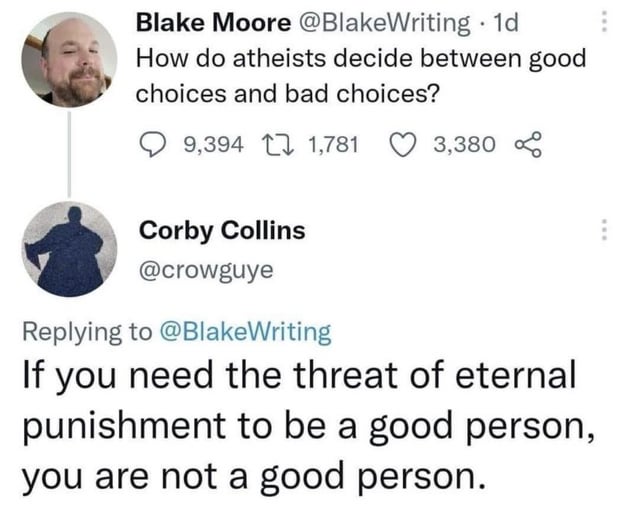
Edit: Incidentally, the first perspective up there is the framing for the post itself. If you don’t go around killing people just because it’s a rule and you want to get your treats, that sounds like sociopathy and be disqualifying from the colloquial use of “good person”. It’s like “well I would stomp that kitten, but Mom says if I stomp kittens I have to go to bed early” which is totally wild. As though if your mom didn’t punish you, you’d just go kitten stomping for fun.


In the way that I think you mean it I would say that such a thing doesn’t exist in a way that is meaningful. On the first place, we would have to agree what “objective evil” even means, but if it’s “the thing that powers the mystical sorting hat of souls” then the discussion is not getting off the ground.
In a more conversational/lexical way where we agree that good" is, well, good, and “evil” is bad I would say that the question posed doesn’t really make sense. It’s like saying “what temperature is objectively hot” which I could only say is either relative or subjective.
I don’t think anybody needs a guide for that discussion, the part you could want a guide for is “what does it mean to me” but only insofar as you want to paint it magically / supernaturally with some greater implication.
So without the “magic sorting hat” telling us what’s objectively good and bad, how does one navigate making the decisions?
I’ve found my own heart trying to rationalize actions that were retrospectively bad ones. Most “bad” people don’t think of themselves as bad. This is a quandary I’ve found myself in, and I’m not sure humans have a good answer to this aside from the theological one.
It’s all a question of framing and goals I suppose.
If it is your position that there is an absolute right being who knows objective standards of good and evil (whatever those words mean to it) and you must do those things to… 🤷. The answer is get to heaven I guess, because you want to go there for some reason to celebrate the supreme being for time without end, then I suppose that’s what you’ve got to do.
If your position is more that there is absolute right and wrong and that by getting these from a god you will have better relationships, or more fulfilled life, or make more money or whatever if you pursue them then ok I guess. That seems to be a little naive. In the first place you will act imperfectly no matter what, and in the second place, you can measure directly against the outcomes you want. For example there are cultural norms, social norms, financial theory, etc.
I am sure there are far more cases philosophically speaking, but a solid argument is in your own comment: if you are TRYING to do good and make the best choices you can, then look back and realize they could be better, it means YOU GOT BETTER. From the standpoint that all of us are imperfect, the best we can do is improve the most we can in the direction we want. If your direction of choice is that one aligned to theology, then yeah I guess there’s your answer. I, for one, want to do all the good person stuff from option 2 above for my earthly benefit. Assessing the relative goodness of options is all that is necessary for that, and society does the rest.
I can’t predict what comes after with absolute certainty, but the idea that “I don’t know absolute right answers” is not sufficient to poof a god argument into existence and to the top of the pile.
Edit: Incidentally, the first perspective up there is the framing for the post itself. If you don’t go around killing people just because it’s a rule and you want to get your treats, that sounds like sociopathy and be disqualifying from the colloquial use of “good person”. It’s like “well I would stomp that kitten, but Mom says if I stomp kittens I have to go to bed early” which is totally wild. As though if your mom didn’t punish you, you’d just go kitten stomping for fun.