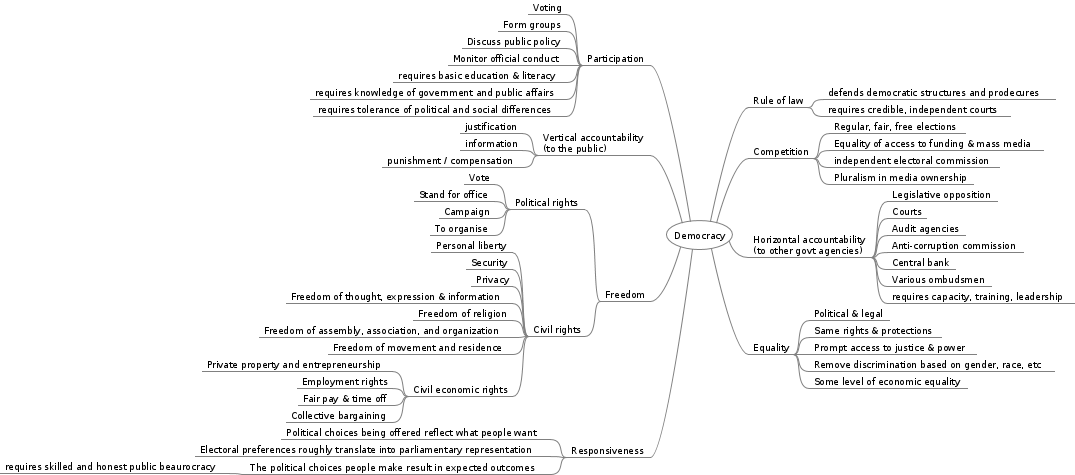

If any of these sub-areas are weak, the whole thing weakens. It’s no wonder that democracy struggles to be effective in so many countries as there’s so many ways it can be undermined. But that can also be it’s strength - different areas reinforce, balance and inspire each other.
Thanks for posting this, it shows how many things are important.
I think it partners well with the book "The Civic Bargain: How Democracy Survives ", which offers some additional thoughts for consideration. (https://press.princeton.edu/books/hardcover/9780691218601/the-civic-bargain)
We face a huge challenge restoring those conditions after what’s been happening here.
Yeah. So many people assume that democracy is just about voting and being able to stand in elections (that’s the political rights branch of the diagram). But that means nothing if, for example, you don’t have freedom of thought, expression and information (civil rights) or if everyone is just trying to avoid starvation (equality) or if anyone is uneducated (participation).
It reminds me of an article I read forever ago on the Bush Administration’s foreign policy. It made a compelling argument that, the immense amount of corruption, graft, and ruthless manipulation for domestic interests aside, the Bush Administration’s interaction with non-hostile governments and government-seeking coalitions was genuine and idealistic in favor of democracy… but based on the immensely flawed and simplistic notion that elections equaled democracy, end of equation. Instead, the truth is that elections are only an expression of a democratic basis that must already exist for the vote to be meaningful - a society run by client systems, for example, has little hope of implementing a serious democracy simply by the establishment of elections, with no other serious ground work.
It was really sobering.
Naah, they knew what they were doing. The prerequisites for democracy must be undergrad-level pol sci, not exactly rocket science.
Remember Project for the New American Century? Of the twenty-five people who signed PNAC’s founding statement of principles, ten went on to serve in the administration of U.S. President George W. Bush.
They invaded Iraq as a demonstration of their power, seeking to strike fear into everyone else.
Everything after that was just trying to make the best of the fallout. Going straight to installing a new dictator wouldn’t have been a good look so they did a shitty halfassed democracy (the best they could have, under the circumstances) instead.
Let me see if I can dig up the article - if memory serves, it excluded Iraq and Afghanistan entirely from the analysis. It was more about how the administration was operating from a fundamentally flawed premise even when it wasn’t acting in a predatory manner.
EDIT: Can’t find it, got tired of looking for it tbh.