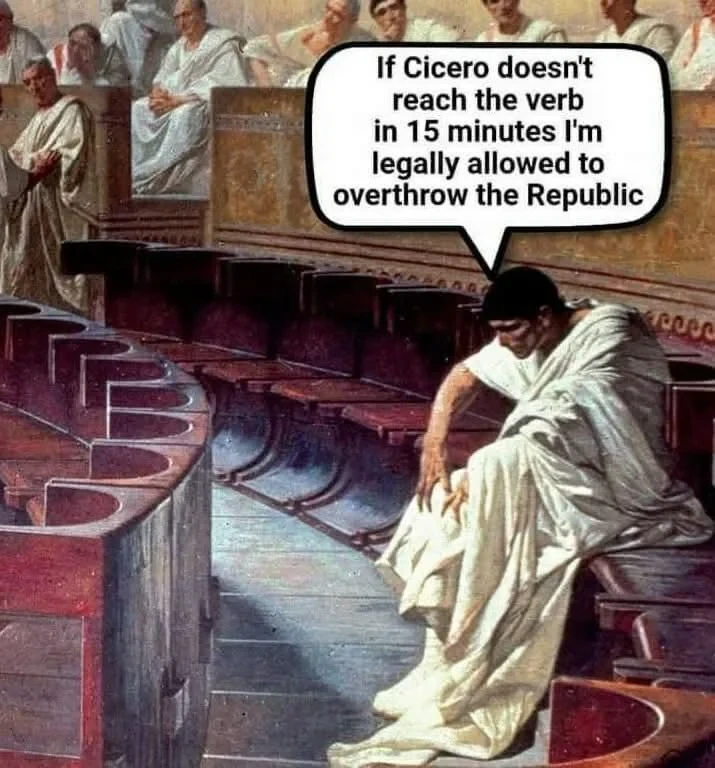

Explanation: The image is from a famous (if not entirely accurate) 19th century painting depicting the Roman conspirator Catiline (pictured) being harangued by the politician and famed orator Cicero.
Catiline was accused (almost certainly correctly) of attempting to overthrow the Roman Republic… but Cicero’s oratory is infamous amongst Latin students for taking forever to place the verb and stop filling up space with nested statements. DRAMATIC EFFECT
If Cicero doesn’t reach the damn verb in the next 15 minutes, Catiline’s coup is perfectly legal!
It’s the only way Roman law could stop Cicero from going on indefinitely. 😔
So how can anyone make sense of a sentence that takes a whole paragraph to get to the verb? What tricks does Laron have to help people keep subject and order straight while waiting around? Was Cicero mocked for keeping such weird language order run on sentences?
It was normal in Latin for the verb to go at the end, or near the end, of a sentence. Latin relies heavily on context and matching up word endings for meaning, rather than word order, I believe. Since word order was largely recommended rather than mandatory, Latin poetry could get very ‘flexible’.
Cicero’s nested statements were considered ornate and eloquent rather than tedious - one assumes assisted by verbal delivery. Very likely there is an element of classism here, though, as Roman society was immensely classist - by showing an elaborate ability to construct sentences that are extensive, wordplay-heavy, embellished, and yet still grammatically correct, Cicero displays higher learning, which was valued as a marker of social class.
Apparently, when Cicero was in his 20s and seeking an advanced rhetoric teacher to hone his style, he was instructed by said teacher in simplifying his rhetoric - a process Cicero seems to think worked and was core to his (then-current) style. One shudders to think of how elaborate pre-correction Cicero might have gotten!
By contrast, Julius Caesar is noted to have had a very simple and clear, yet pleasing, style of writing/speech, and both Cicero and Caesar - despite being on opposite political sides - expressed admiration for the other’s literary/rhetorical ability, with Caesar regarding Cicero as the master of Latin literary rhetoric, and Cicero regarding Caesar’s writings as so pure (stylistically) and clear that there could simply be no improving on them.
Latin poetry could get very ‘flexible’.
Ovid is the worst offender in that department. He basically took all the words he wanted to say and arranged them in order to achieve the perfect rhythm. Because Roman poetry wasn’t about rhymes, but rhythm.